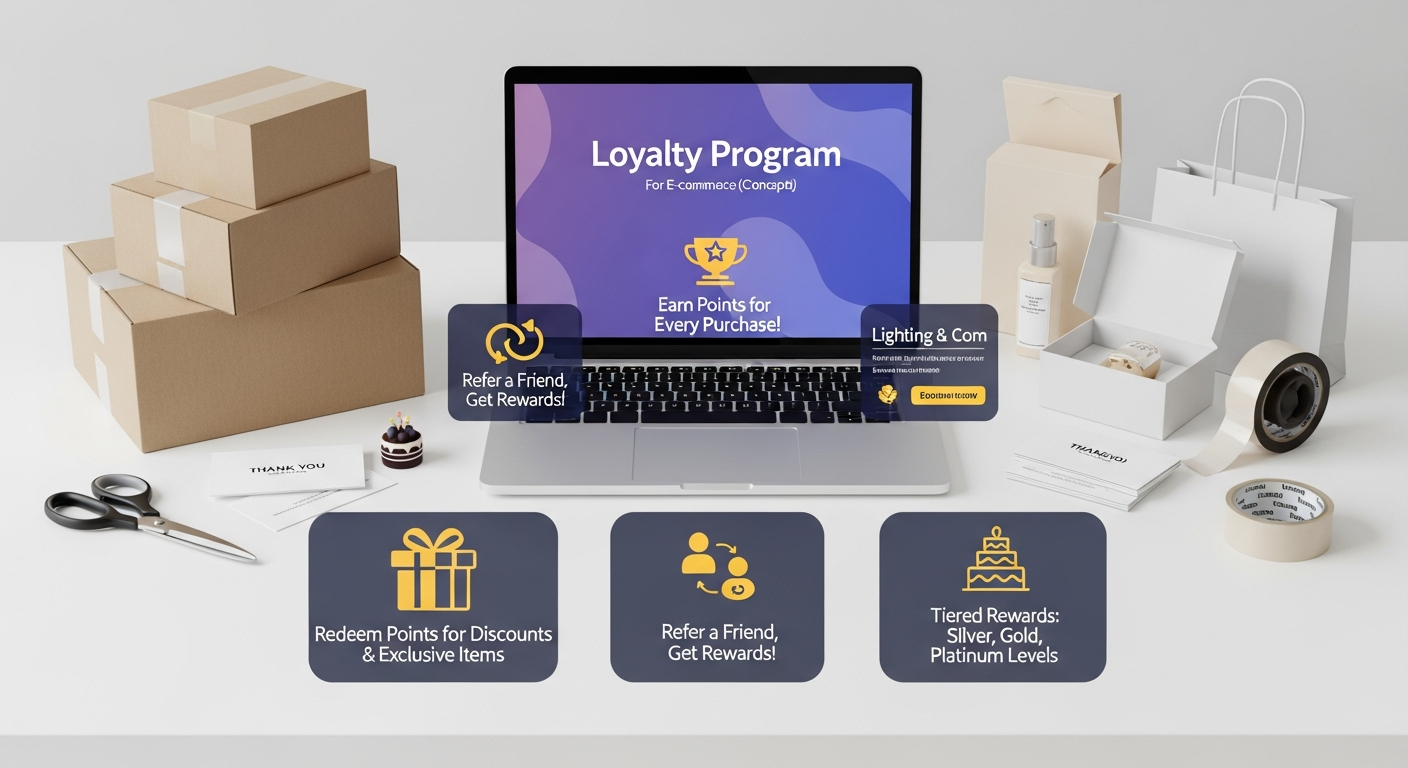
Unlock Unstoppable Growth: Crafting E-commerce Loyalty Programs That Drive Repeat Business & Skyrocket LTV

Unlock Unstoppable Growth: Crafting E-commerce Loyalty Programs That Drive Repeat Business & Skyrocket LTV
Categories:
Date:
February 25, 2026

Unlock Unstoppable Growth: Crafting E-commerce Loyalty Programs That Drive Repeat Business & Skyrocket LTV

In the relentless arena of e-commerce, customer acquisition costs continue to climb. For most online businesses, the cold, hard truth is that acquiring a new customer can be five to twenty-five times more expensive than retaining an existing one. This isn’t just a statistic; it’s a fundamental challenge to your bottom line. At E-CompProfits, we believe sustainable growth hinges on more than just attracting new buyers – it’s about transforming one-time shoppers into lifelong advocates.

Enter the loyalty program: often misunderstood as a mere discount scheme, but in reality, a potent, strategic engine for exponential growth. A well-designed loyalty program doesn’t just offer crumbs; it builds a vibrant ecosystem of engagement, trust, and mutual value, ensuring your customers keep coming back, spend more, and tell their friends. This comprehensive guide will arm you with the actionable strategies, innovative ideas, essential tools, and real-world insights to design, launch, and optimize an e-commerce loyalty program that doesn’t just reward purchases, but rewards loyalty – propelling your business forward.

Why Loyalty Programs Are Your E-commerce Secret Weapon

Forget the myth that loyalty programs are only for big brands with massive budgets. For any e-commerce business, regardless of size, a strategic loyalty program is not a luxury; it’s a necessity for sustainable, profitable growth. Here’s why:

  • Dramatic Reduction in Customer Acquisition Cost (CAC): As mentioned, acquiring new customers is expensive. By focusing on retention, you reduce the need to constantly pour resources into new acquisitions, freeing up budget for other growth initiatives or higher profit margins.
  • Significant Boost in Customer Lifetime Value (CLTV): Loyal customers spend more over their lifetime with your brand. They make repeat purchases, often have higher average order values (AOV), and are less price-sensitive. A study by Bain & Company found that a 5% increase in customer retention can boost company profits by 25% to 95%.
  • Increased Average Order Value (AOV): Loyalty programs often incentivize higher spending to unlock better rewards or reach higher tiers. This encourages customers to add more items to their cart, directly impacting your AOV.
  • Enhanced Brand Advocacy and Word-of-Mouth Marketing: Happy, loyal customers become your most powerful marketing channel. They refer friends, share their positive experiences on social media, and leave glowing reviews. This organic growth is invaluable and far more trustworthy than paid advertising.
  • Valuable Data for Personalization: Loyalty programs are data goldmines. They provide insights into purchasing habits, preferences, and engagement levels. This data allows you to segment your audience, personalize offers, and tailor communication, making your marketing efforts far more effective.
  • Competitive Differentiation: In a crowded e-commerce landscape, a compelling loyalty program can be a key differentiator, giving customers a reason to choose you over competitors who only offer transactional discounts.

Ultimately, a loyalty program shifts your customer relationships from purely transactional to deeply relational. It’s an investment in your customer base that pays dividends in repeat business, higher revenue, and a stronger brand community.

The Core Pillars of a High-Impact Loyalty Program

Before diving into specific ideas, understand the foundational principles that make any loyalty program effective. Skipping these steps is like building a house without a blueprint – it might stand, but it won’t be robust or functional in the long run.

  • Clarity & Simplicity: If your customers can’t understand how to earn points, what the rewards are, or how to redeem them within seconds, your program will fail. Keep the rules straightforward, the benefits clear, and the redemption process frictionless. Avoid complex calculations or hidden terms.
  • Irresistible Value Proposition: Your rewards must be genuinely appealing and relevant to your target audience. Generic discounts are a start, but exclusive products, VIP experiences, early access, or even charitable donations can resonate more deeply. The perceived value must outweigh the effort of participation.
  • Tiered Structure for Aspiration & Gamification: While not mandatory for every program, a tiered system (e.g., Bronze, Silver, Gold) injects an element of gamification. Customers are motivated to spend more to unlock higher tiers with progressively better benefits. This creates aspirational goals and fosters a sense of achievement and exclusivity.
  • Exclusivity & Community Building: Make your loyal customers feel special. Offer members-only perks, private sales, or a dedicated community forum. This fosters a sense of belonging and reinforces their identity as valued members of your brand’s inner circle.
  • Deep Personalization: Leverage the data you collect. Instead of generic offers, provide tailored recommendations and rewards based on past purchases, browsing history, or stated preferences. A customer who buys pet food won’t care about a discount on baby clothes. Personalization makes rewards feel more valuable and relevant.
  • Seamless Integration & User Experience: Your loyalty program must integrate seamlessly with your existing e-commerce platform and customer touchpoints. Enrollment should be effortless (often automatic with an account), points balances easily visible, and redemption quick and intuitive during checkout. A clunky experience will deter participation.
💡 Strategy Tip

By building your program on these pillars, you create a robust framework that not only rewards transactions but cultivates genuine customer loyalty and engagement.

Innovative Loyalty Program Ideas Beyond Basic Points

While a simple points-for-purchase system is a solid starting point, the most successful e-commerce loyalty programs go further, integrating diverse reward mechanisms and experiences. Here are several powerful ideas to inspire your strategy:

1. The Enhanced Points-Based System

This is the bedrock for most programs, but you can significantly enhance it beyond just “1 point per dollar.”

  • Diverse Earning Opportunities:
    • Purchases: Standard 1x points, but offer bonus points (e.g., 2x or 3x) for specific product categories, during promotions, or on a customer’s birthday.
    • Non-Purchase Actions: Reward for actions that build community and brand affinity:
      • Signing up for your newsletter (e.g., 50 points).
      • Following you on social media (e.g., 25 points per platform).
      • Leaving a product review (e.g., 100 points, especially for photo/video reviews).
      • Referring a friend (e.g., 500 points when the friend makes their first purchase).
      • Completing their profile or a survey (e.g., 75 points).
      • Celebrating a birthday or anniversary with your brand.
  • Flexible Redemption Options:
    • Discounts: Still powerful. Offer tiered discounts (e.g., 500 points for $5 off, 1000 points for $15 off).
    • Free Shipping: A highly coveted reward that encourages smaller, more frequent purchases.
    • Exclusive Products/Bundles: Create items or bundles only available for points redemption.
    • Early Access: To new product launches, sales, or limited editions.
    • Donations: Allow customers to convert points into a donation to a charity of their choice (or one you partner with). This resonates deeply with socially conscious consumers.
  • Real-World Example: Sephora’s Beauty Insider. It’s a classic for a reason. Customers earn points for every purchase, which they can redeem for product samples, exclusive sets, or even beauty services. Crucially, it has a tiered structure (Insider, VIB, Rouge) with escalating benefits like free shipping, exclusive events, and dedicated customer service, driving aspirational spending.

2. Tiered Loyalty Programs

This adds a compelling gamified element, encouraging customers to spend more to unlock progressively better benefits and a higher status.

  • Structure: Typically 2-4 tiers (e.g., Member, Silver, Gold, Platinum).
    • Entry Tier: Basic benefits (e.g., points for purchase, birthday discount).
    • Mid-Tiers: Enhanced benefits (e.g., higher point multipliers, free shipping, early access to sales).
    • Top Tier (VIP): Exclusive perks (e.g., dedicated customer support, personalized gifts, exclusive events, free expedited shipping, private sales).
  • Qualification: Customers typically qualify for tiers based on annual spend or a certain number of purchases within a timeframe.
  • Benefits:
    • Increased feeling of exclusivity and recognition.
    • Strong incentive to reach the next tier.
    • Higher CLTV from customers striving for status.
  • Real-World Example: Starbucks Rewards. Customers earn “Stars” for purchases. More Stars unlock “Green Level” (free refills, birthday reward) and then “Gold Level” (personalized offers, free food/drinks). The app integration is seamless, making it incredibly easy to track progress and redeem.

3. Subscription-Based / Paid Loyalty Programs

This is a more advanced strategy, often seen with larger retailers, but can be highly effective for businesses with high repeat purchase potential or a strong niche.

  • Concept: Customers pay an annual or monthly fee to access a suite of premium benefits.
  • Benefits for Customers:
    • Unlimited free shipping (most common and powerful).
    • Exclusive discounts on all products.
    • Early access to new products or sales.
    • Premium content or services.
    • Expedited customer support.
  • Benefits for Your Business:
    • Guaranteed revenue stream from membership fees.
    • Higher engagement and higher frequency of purchases from members (they want to maximize their membership value).
    • Stronger psychological commitment to your brand.
  • Considerations: Requires a strong value proposition to justify the fee. Ideal for businesses where customers make frequent purchases.
  • Real-World Example: Amazon Prime. While a giant, it perfectly illustrates the power of paid loyalty: free expedited shipping, streaming services, exclusive deals. Members spend significantly more than non-members. REI Co-op Membership is another great example, offering an annual dividend, special pricing, and access to unique experiences for a one-time fee.

4. Experiential & Community Rewards

Move beyond transactional rewards to offer unique experiences that deepen brand connection.

  • Ideas:
    • Exclusive Events: Virtual workshops, product demos, Q&A sessions with founders or experts.
    • Early Access: To new product lines, limited edition drops, or beta testing programs.
    • Personalized Consultations: With product specialists, stylists, or experts related to your niche.
    • Behind-the-Scenes Content: Videos or articles showing your product creation process, ethical sourcing, or company culture.
    • User-Generated Content (UGC) Showcases: Feature loyal customers on your website, social media, or in marketing materials.
  • Benefits: Creates memorable experiences, fosters a strong emotional connection, and builds a sense of community around your brand.
  • Real-World Example: Patagonia’s Worn Wear Program. While not a traditional points program, it exemplifies experiential loyalty by offering repair services, trade-ins, and promoting the longevity of their products, deeply aligning with their customer’s values and fostering a highly loyal community.

5. Gamified Loyalty Programs

Inject fun and challenge into your program to increase engagement and repeat visits.

  • Ideas:
    • Badges & Achievements: Reward customers with digital badges for milestones (e.g., “First Purchase,” “Reviewer Extraordinaire,” “Eco-Warrior” for sustainable purchases).
    • Challenges: Set specific tasks for customers to complete to earn bonus points or exclusive rewards (e.g., “Spend $X in a month,” “Refer 3 friends,” “Purchase from 3 different categories”).
    • Leaderboards: Display top point earners (with their permission) to foster friendly competition.
    • Spin-the-Wheel/Scratch Cards: Offer a chance to win bonus points or discounts after a purchase or specific action.
  • Benefits: Increases engagement, makes the purchasing journey more enjoyable, and encourages exploration of your product catalog.
  • Real-World Example: NikePlus. Offers exclusive products, personalized training programs, and early access to drops. The gamified elements come through challenges and the sense of being part of a high-performance community.
PRO TIP: Don’t try to implement all these ideas at once. Start with a solid points-based system and a clear value proposition. Once that’s established and performing, layer on tiers, experiential rewards, or gamification to continually enhance the customer experience.

Tools & Tech Stack for Building Your Loyalty Program

Implementing a robust loyalty program doesn’t require custom coding or a massive development team. A range of dedicated platforms and integrations make it accessible for businesses of all sizes.

Dedicated Loyalty Platforms (Shopify Apps & Standalone)

These are purpose-built solutions designed to manage points, rewards, tiers, and customer data. For most e-commerce businesses, especially those on Shopify or similar platforms, these are the go-to choice.

  • Smile.io (Recommended for SMBs):
    • Features: Points, referrals, VIP tiers, integrations with email marketing (Klaviyo), reviews (Yotpo), and more. Highly customizable branding.
    • Cost: Free plan for basic points and referral programs (up to 100 orders/month). Paid plans start around $49/month (Starter) for more features like VIP tiers, custom rewards, and higher order limits. The Growth plan ($199/month) offers advanced segmentation and integrations.
    • Why we recommend it: Excellent balance of features, ease of use, and scalability for small to medium-sized businesses. It integrates seamlessly with Shopify.
  • LoyaltyLion:
    • Features: Comprehensive loyalty platform with advanced segmentation, analytics, and personalization. Supports points, tiers, referrals, and a wide range of earning actions.
    • Cost: Free plan (up to 800 orders/month). Accelerator plan starts at $159/month, and Advanced plan starts at $350/month, scaling up for larger stores.
    • Why consider it: More powerful analytics and deeper customization options, suitable for growing and larger e-commerce stores seeking granular control.
  • Yotpo Loyalty & Referrals:
    • Features: Part of the broader Yotpo suite (reviews, SMS marketing), offering loyalty, referrals, and VIP programs. Strong integration within the Yotpo ecosystem.
    • Cost: Free plan for basic loyalty/referrals. Growth plans start around $29/month, scaling up significantly based on features and usage.
    • Why consider it: If you’re already using Yotpo for reviews or SMS, this offers a cohesive solution within a single vendor’s ecosystem.
  • Enterprise Solutions (for larger businesses):
    • Antavo, Annex Cloud, Zinrelo: These platforms offer highly sophisticated, omni-channel loyalty solutions for multi-million dollar businesses. They provide extensive customization, advanced analytics, and integrations with ERP, CRM, and POS systems.
    • Cost: Typically custom pricing, often starting from $1,000s to $10,000s per month, reflecting their enterprise-grade capabilities.

Essential Integrations

  • Email Marketing Platform (e.g., Klaviyo, Mailchimp, Omnisend): Crucial for communicating loyalty program updates, point balances, reward reminders, and personalized offers. Most loyalty platforms integrate directly.
  • Customer Service Platform (e.g., Gorgias, Zendesk): Allows your support team to view customer loyalty status and points, enabling them to provide better, more personalized service.
  • Analytics Tools (e.g., Google Analytics, Shopify Analytics): While loyalty platforms have their own dashboards, integrate with your primary analytics tools to track the holistic impact of your program on CLTV, AOV, and repeat purchase rates.

When selecting a platform, prioritize ease of integration with your existing e-commerce setup, robust features that align with your program ideas, and clear analytics to measure ROI. Start with a platform like Smile.io or LoyaltyLion, which offer free or affordable starter plans, and scale up as your program grows and your needs evolve.

Launching & Optimizing Your Loyalty Program for Maximum ROI

Launching a loyalty program isn’t a “set it and forget it” endeavor. Success hinges on strategic planning, effective promotion, and continuous optimization. Here’s a roadmap to ensure maximum return on investment:

1. Define Clear Goals & Key Performance Indicators (KPIs)

Before you even choose a platform, determine what success looks like. Your goals should be SMART (Specific, Measurable, Achievable, Relevant, Time-bound).

  • Example Goals:
    • Increase repeat purchase rate by 15% within 12 months.
    • Boost average customer lifetime value (CLTV) by 20% over 18 months.
    • Increase loyalty program enrollment by 30% in the first 6 months.
    • Achieve a 40% redemption rate for points/rewards within the first year.
    • Increase average order value (AOV) from loyal customers by 10%.
  • Key Metrics to Track:
    • Enrollment Rate: Percentage of customers who join the program.
    • Active Member Rate: Percentage of members who have earned or redeemed points recently.
    • Redemption Rate: How often rewards are claimed.
    • Repeat Purchase Rate: The core metric. Compare members vs. non-members.
    • Average Order Value (AOV): For loyalty members vs. non-members.
    • Customer Lifetime Value (CLTV): The ultimate measure of success.
    • Churn Rate: How many loyal customers stop engaging.
    • Referral Rate: If your program includes a referral component.

2. Plan Your Pilot Program & Soft Launch

Don’t launch to your entire customer base immediately. Start small to test the waters.

  • Internal Testing: Ensure all mechanics (earning, redeeming, tracking) work flawlessly.
  • Friends & Family/VIP Customer Soft Launch: Invite a small segment of your most loyal customers to join first. Gather their feedback on clarity, value, and user experience. This also makes them feel extra special.
  • Refine: Use the feedback to iron out any kinks before a full public launch.

3. Promote Your Program Heavily & Clearly

Customers can’t join what they don’t know exists. Make your loyalty program highly visible across all your customer touchpoints.

  • Website:
    • Dedicated “Loyalty Program” page with clear FAQs.
    • Prominent banner on your homepage.
    • Pop-ups for new visitors.
    • Call-to-action on product pages and at checkout.
    • Display points earned on product pages and in the cart.
  • Email Marketing:
    • Announce the launch with an exciting email campaign.
    • Regularly remind customers of their point balance and available rewards.
    • Segment campaigns to encourage specific actions (e.g., “You’re X points away from $Y off!”).
  • Social Media:
    • Create engaging posts and stories.
    • Highlight exclusive rewards and member benefits.
    • Run contests for bonus points.
  • Offline (if applicable): In-store signage, flyers in packages.

Crucial: Educate your customers. Clearly explain the benefits, how to earn, and how to redeem. Use simple language and visuals.

4. Analyze, Iterate, and Optimize Continuously

Your loyalty program should be a living entity, constantly evolving based on data and customer feedback.

  • Regularly Review KPIs: Monitor your defined metrics weekly/monthly. Are you hitting your targets? Why or why not?
  • A/B Test Elements: Experiment with different reward values, earning actions, or even program names to see what resonates most with your audience.
  • Segment Your Audience: Not all customers are the same. Use your loyalty data to create segments and offer personalized rewards or incentives. For example, incentivize churn risks with bonus points or exclusive offers.
  • Gather Feedback: Use surveys, customer service interactions, and social media comments to understand what customers love and what could be improved.
  • Refresh Rewards: Keep your rewards fresh and exciting. Periodically introduce new exclusive products, experiences, or partners to maintain interest.
  • Prevent Fraud: Monitor for suspicious activity (e.g., excessive referrals from the same IP, fake reviews for points). Most loyalty platforms have built-in fraud detection.

By treating your loyalty program as an ongoing strategic initiative rather than a one-time launch, you ensure it remains a powerful engine for customer retention and long-term business growth.

Conclusion: Your Path to Lasting E-commerce Success

In the dynamic world of e-commerce, the battle isn’t just for the next sale; it’s for the next decade of customer relationships. A thoughtfully designed and diligently managed loyalty program is no longer an optional add-on but a strategic imperative. It’s the engine that transforms transient transactions into enduring loyalty, converting one-time buyers into powerful brand advocates, and fundamentally shifting your business towards sustainable, profitable growth.

By understanding the core pillars, embracing innovative reward ideas, leveraging the right technology, and committing to continuous optimization, you can build a loyalty program that doesn’t just offer discounts, but delivers genuine value, fosters deep connections, and secures your place in the hearts (and wallets) of your customers. Stop chasing every new customer; start nurturing the ones you have. The investment you make in loyalty today will pay exponential dividends for years to come. Now, go forth and build a loyalty program that truly rewards – and grows – your business.

“`json
{
“@context”: “https://schema.org”,
“@graph”: [
{
“@type”: “Article”,
“headline”: “Unlock Unstoppable Growth: Crafting E-commerce Loyalty Programs That Drive Repeat Business & Skyrocket LTV”,
“description”: “A comprehensive, practical guide for e-commerce business owners on designing, launching, and optimizing high-impact loyalty programs to boost customer retention, average order value, and lifetime value. Includes innovative ideas, tool recommendations, and strategic advice.”,
“image”: {
“@type”:

Written By

Explore more articles

Contact Us

Want to learn more about us? Complete this form and someone from our team will be in touch soon.

Jessie Guerrero

Recent Articles