
The Indispensable Role of Ecommerce Analytics in Modern Business
The digital marketplace is a battlefield of constant change, where consumer preferences shift rapidly, and competition is fierce. In such an environment, intuition alone is insufficient. Ecommerce analytics provides the compass and map, guiding your strategic decisions with empirical evidence rather than mere guesswork. Imagine launching a new product line or a marketing campaign without knowing its impact on your target audience, or understanding how visitors interact with your website. That’s precisely what operating without proper analytics entails.
For those contemplating How To Start Ecommerce Business 2026, integrating analytics from day one is not merely advisable; it is critical. The foundational setup of your analytics tools, such as Google Analytics 4 (GA4), should be among your very first steps. Early tracking allows you to establish benchmarks, identify initial user behavior patterns, and swiftly pivot your strategies if necessary. This proactive approach minimizes wasted resources and maximizes the potential for early success.
Analytics empowers you to:
- Identify Growth Opportunities: Pinpoint which products are performing best, which marketing channels are most effective, and where your customers are coming from.
- Optimize User Experience (UX): Understand how visitors navigate your site, where they encounter friction, and which elements contribute to conversions or abandonment. This insight is invaluable for refining your website design and functionality.
- Enhance Marketing ROI: Measure the effectiveness of your advertising campaigns, allowing you to allocate your budget more efficiently to channels that deliver the highest return.
- Improve Customer Understanding: Gain deep insights into your customer demographics, purchasing habits, and lifetime value, enabling more personalized communication and product offerings.
- Mitigate Risks: Detect potential issues early, such as sudden drops in traffic, increased bounce rates, or technical glitches that could be impacting sales.
In essence, ecommerce analytics transforms your online store from a static storefront into a dynamic, data-driven engine for growth. It moves you beyond anecdotal evidence and empowers you with concrete data to make informed decisions that directly impact your bottom line. As we look towards 2026, the businesses that will dominate are those that master the art of data interpretation and strategic implementation.
Essential Metrics for Understanding Your Customers & Site Performance
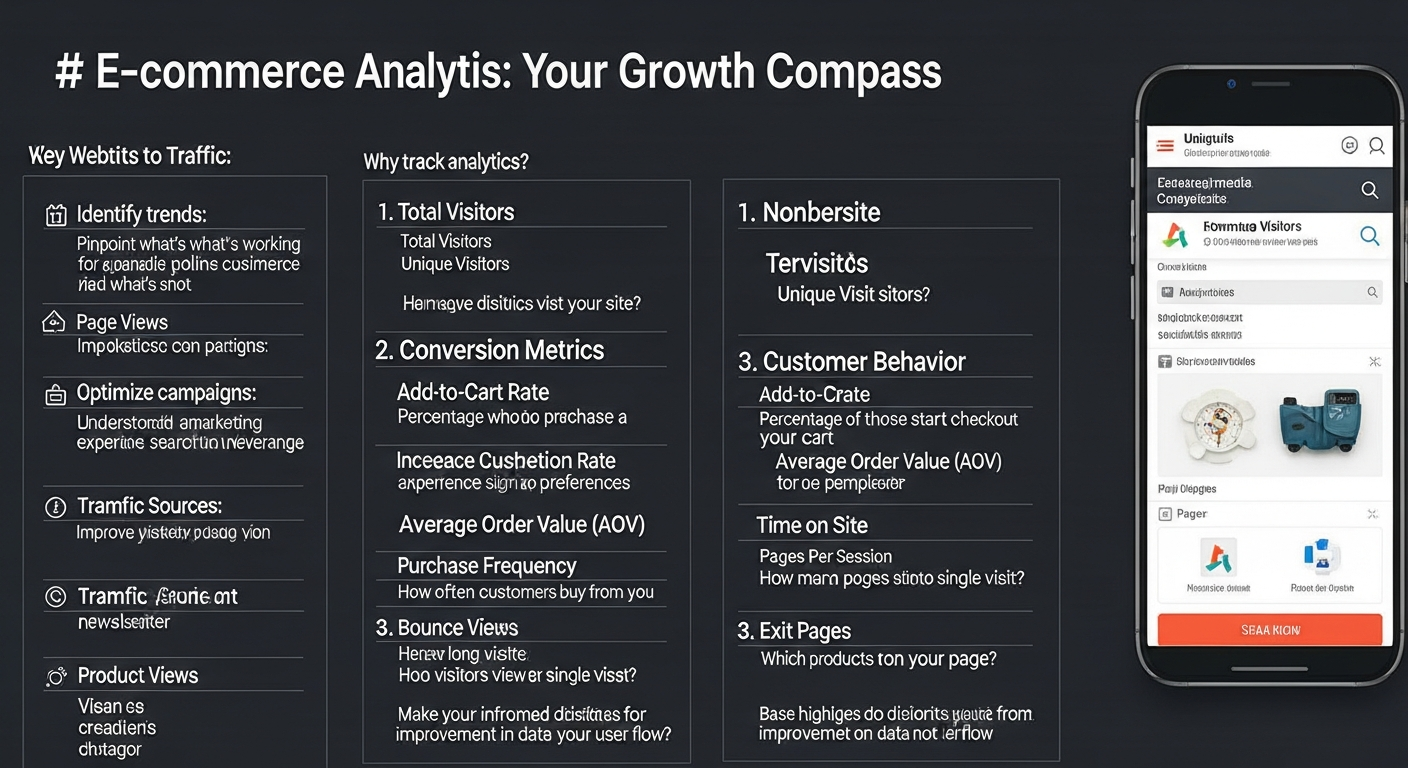
Before diving into conversion and revenue, it’s crucial to understand how visitors arrive at your site and how they engage with it. These foundational metrics paint a picture of your audience and the initial health of your online presence.
Traffic & Acquisition Metrics: Where Do Your Customers Come From?
- Unique Visitors: The number of individual users who visited your site within a specific period. This tells you the breadth of your audience.
- Sessions: The total number of times users interacted with your site. A single unique visitor can have multiple sessions. This metric helps understand engagement frequency.
- Page Views: The total number of pages viewed. A higher number often indicates deeper engagement, though it can also signal user confusion if combined with a high exit rate on critical pages.
- Traffic Sources: Understanding where your visitors originate (e.g., Organic Search, Paid Search, Social Media, Direct, Referral) is paramount. This insight helps you evaluate the effectiveness of different marketing channels. For example, a strong Referral Marketing Program Ecommerce will show up clearly in your referral traffic, allowing you to gauge its success.
- New vs. Returning Visitors: The ratio of first-time visitors to those who have visited before. A healthy balance indicates both effective acquisition and successful retention efforts. Returning visitors often have higher conversion rates.
- Bounce Rate: The percentage of visitors who land on a page and leave without interacting further (e.g., clicking on another link, navigating to a different page). A high bounce rate can indicate poor landing page relevance, slow load times, or confusing design.
- Exit Rate: The percentage of visitors who leave your site from a specific page. While similar to bounce rate, exit rate applies to any page on your site, not just the entry page. A high exit rate on a product page, for instance, might signal issues with product descriptions or pricing.
Engagement Metrics: How Do Users Interact with Your Site?
- Average Session Duration: The average amount of time users spend on your site during a single session. Longer durations generally indicate higher engagement and interest.
- Pages Per Session: The average number of pages a user views during a single session. A higher number suggests users are exploring your content more deeply.
- Scroll Depth: Measures how far down a page users scroll. This is particularly useful for long-form content or product pages to ensure important information is seen.
- Add to Cart Rate: The percentage of product views that result in an item being added to a shopping cart. This is a crucial pre-conversion metric indicating product interest.
- Product Detail Page Views: The number of times specific product pages are viewed. This helps identify popular products and potential areas for optimization.
- Internal Site Search Usage: Tracking how often users utilize your site’s search bar and what terms they search for provides direct insight into their intent and what they’re looking for but might not be finding easily.
By meticulously tracking these metrics, you gain a foundational understanding of your audience’s initial journey and interaction with your e-commerce platform. This data forms the bedrock upon which you can build more sophisticated analyses and make informed decisions about your website’s content, structure, and promotional strategies, setting the stage for success well into 2026.
Conversion-Centric Metrics That Drive Revenue
Sales & Revenue Metrics: The Bottom Line
- Total Revenue: The gross income generated from sales over a period. This is your most straightforward measure of success.
- Average Order Value (AOV): The average amount of money a customer spends per transaction. Increasing AOV through strategies like upselling, cross-selling, or minimum spend for free shipping can significantly boost profitability without needing more traffic.
- Conversion Rate: The percentage of website visitors who complete a desired action, most commonly making a purchase. This can be tracked overall, or for specific stages (e.g., product page to cart, cart to checkout, checkout completion). A low conversion rate despite high traffic signals issues in your sales funnel.
- Gross Profit Margin: The percentage of revenue left after deducting the cost of goods sold (COGS). While not purely an analytics metric, understanding this in conjunction with sales data helps assess true profitability.
- Return on Ad Spend (ROAS): The revenue generated for every dollar spent on advertising. This metric is crucial for evaluating the effectiveness of your paid marketing campaigns and optimizing your ad budget.
Customer Behavior & Funnel Metrics: Optimizing the Path to Purchase
- Abandoned Cart Rate: The percentage of users who add items to their cart but do not complete the purchase. This is a critical metric for e-commerce, as high abandonment often indicates issues like unexpected shipping costs, a complicated checkout process, or lack of trust. Strategies like abandoned cart email sequences can help recover these potential sales.
- Checkout Abandonment Rate: A more specific metric focusing on users who begin the checkout process but do not complete it. This pinpoints friction points within the final stages of the buying journey.
- Product View to Purchase Rate: The percentage of users who view a specific product page and then go on to purchase that product. This helps assess the effectiveness of individual product pages and descriptions.
- Refund Rate/Return Rate: The percentage of sales that result in a return or refund. A high return rate can indicate issues with product quality, inaccurate descriptions, or even an overly generous Ecommerce Return Policy Best Practices. Tracking this helps you refine product listings, improve quality control, and adjust your return policy for optimal balance between customer satisfaction and profitability.
- Payment Method Preferences: Understanding which payment methods your customers prefer can inform your checkout options, reducing friction for potential buyers.
These conversion metrics are the pulse of your e-commerce business. By diligently monitoring them, you can identify bottlenecks in your sales funnel, optimize your product offerings, refine your pricing strategies, and ultimately drive greater revenue. For businesses aiming to scale by 2026, consistent improvement in these areas is non-negotiable.
Unpacking Customer Lifetime Value (CLV) & Retention

While acquiring new customers is important, retaining existing ones and maximizing their value over time is often more cost-effective and contributes significantly to long-term profitability. These metrics shift focus from single transactions to the entire customer relationship.
Loyalty & Retention Metrics: Building Lasting Relationships
- Customer Lifetime Value (CLV): This is arguably one of the most important metrics for sustainable growth. CLV is the total revenue a business can reasonably expect from a single customer account over their relationship with the business. Calculating CLV involves factors like average purchase value, purchase frequency, and customer lifespan. Understanding your CLV helps you justify customer acquisition costs, segment customers for targeted marketing, and prioritize retention efforts. For instance, if your CLV is $500, you know you can afford to spend up to that amount (or a healthy percentage of it) to acquire a new customer and still be profitable over time.
- Customer Acquisition Cost (CAC): The total cost associated with acquiring a new customer. This includes all marketing, sales, and promotional expenses divided by the number of new customers acquired within a specific period. Comparing CLV to CAC is critical; ideally, your CLV should be significantly higher than your CAC (e.g., a 3:1 ratio is often considered healthy).
- Repeat Purchase Rate: The percentage of customers who have made more than one purchase from your store. A high repeat purchase rate indicates strong customer satisfaction and loyalty. This metric is a direct indicator of your ability to retain customers.
- Customer Retention Rate: The percentage of existing customers a business retains over a specific period. A higher retention rate means fewer customers are churning, leading to more predictable revenue streams.
- Churn Rate: The opposite of retention rate, representing the percentage of customers who stop doing business with you over a given period. High churn is a red flag, indicating potential issues with product quality, customer service, or competitive offerings.
- Purchase Frequency: The average number of times customers purchase from your store within a specific period. Increasing purchase frequency is a powerful way to boost CLV.
These metrics are particularly relevant when evaluating the success of initiatives like a Referral Marketing Program Ecommerce. While a referral program directly impacts new customer acquisition, its true value is amplified if those referred customers become loyal, high-CLV individuals. Tracking CLV for referred customers versus organically acquired customers can provide powerful insights into the quality and long-term impact of your referral efforts.
By focusing on CLV and retention, e-commerce businesses can shift from a transactional mindset to a relationship-centric approach. This long-term perspective is essential for building a resilient and profitable business that can adapt and thrive beyond 2026, ensuring that the effort and investment in acquiring a customer continue to pay dividends over many years.
Technical Performance & User Experience (UX) Metrics
Even with compelling products and brilliant marketing, a poor technical foundation or frustrating user experience can derail all your efforts. These metrics, often overlooked, are crucial for ensuring your site is accessible, fast, and enjoyable to use, directly impacting conversion and retention.
Site Speed & Core Web Vitals: The Foundation of Good UX
- Page Load Speed: The time it takes for a page to fully load. In today’s fast-paced digital world, every second counts. Slow loading times directly lead to higher bounce rates and lower conversion rates. Google’s research shows that as page load time goes from 1 second to 3 seconds, the probability of bounce increases by 32%.
- Core Web Vitals (CWV): These are specific factors Google considers important in the overall user experience of a webpage. They include:
- Largest Contentful Paint (LCP): Measures loading performance. It reports the render time of the largest image or text block visible within the viewport. Aim for 2.5 seconds or less.
- First Input Delay (FID): Measures interactivity. It quantifies the time from when a user first interacts with a page (e.g., clicks a button) to when the browser is actually able to respond to that interaction. Aim for 100 milliseconds or less.
- Cumulative Layout Shift (CLS): Measures visual stability. It quantifies unexpected layout shifts of visual page content. Aim for 0.1 or less.
Optimizing for CWV is not just about pleasing Google; it’s about providing a seamless and frustration-free experience for your users, which directly correlates with better engagement and conversions.
Mobile Responsiveness & Usability: Reaching Every User
- Mobile Traffic vs. Desktop Traffic: The percentage of your visitors coming from mobile devices versus desktops. Given the dominance of mobile browsing, ensuring a flawless mobile experience is non-negotiable.
- Mobile Conversion Rate: How well your site converts visitors on mobile devices compared to desktop. If there’s a significant disparity, it indicates mobile-specific UX issues.
- Responsive Design Breakpoints: Analyzing how your site performs on various screen sizes and devices, identifying any elements that break or become unusable.
- Tap Target Size: On mobile, buttons and links need to be large enough and spaced appropriately to be easily tapped. Analytics can highlight areas where users might be struggling.
Site Health & Accessibility: Ensuring Smooth Operation
- Error Rates (404s, JavaScript Errors): Tracking broken links (404 Not Found errors) and JavaScript errors is crucial. These issues can disrupt user journeys, prevent content from loading, and harm your search engine rankings.
- Uptime/Downtime: The percentage of time your website is operational and accessible. Any downtime means lost sales and damaged reputation.
- Accessibility Scores: While not a direct analytics metric, regularly auditing your site for accessibility (e.g., contrast ratios, alt text, keyboard navigation) ensures a wider audience can use your site, which can be indirectly measured by broader reach and engagement.
Investing in the technical health and user experience of your e-commerce site is foundational. A beautiful product and compelling marketing will only go so far if your website is slow, broken, or difficult to navigate. Prioritizing these technical and UX metrics ensures that your online store is always performing at its best, providing a solid platform for growth and customer satisfaction well into 2026 and beyond.
Setting Up Your Analytics Foundation for 2026 and Beyond
Understanding what to track is only half the battle; the other half is effectively setting up, maintaining, and utilizing your analytics tools. As we look towards 2026, the complexity and sophistication of analytics platforms continue to evolve, making a robust setup more critical than ever.
Choosing the Right Tools
- Google Analytics 4 (GA4): This is the current industry standard, offering a powerful, event-driven data model. Unlike its predecessor (Universal Analytics), GA4 is designed for cross-platform tracking (web and app) and provides a more holistic view of the customer journey. Proper implementation of GA4, including custom events and parameters, is essential for granular insights.
- Other Analytics Platforms: Depending on your business size and specific needs, you might consider alternatives or complementary tools like Adobe Analytics, Mixpanel (for product analytics), or bespoke enterprise solutions. Many e-commerce platforms (Shopify, WooCommerce, BigCommerce) also offer built-in analytics dashboards that provide quick overviews.
- Tag Management Systems (TMS): Tools like Google Tag Manager (GTM) are indispensable. A TMS allows you to easily add and update website tags (tracking codes) without modifying your website’s code directly. This streamlines the process of implementing GA4, conversion pixels for ads, and other tracking scripts, reducing reliance on developers and minimizing errors.
Defining Goals and Event Tracking
- Strategic Goal Setting: Before you even look at data, define what success means for your business. Is it total revenue, number of new customers, average order value, or something else? Your analytics setup should align directly with these strategic goals.
- Event-Driven Data: GA4 operates on an event-driven model. This means almost every user interaction (page view, click, scroll, video play, add to cart, purchase) can be tracked as an event. Meticulously setting up custom events for key interactions in your sales funnel provides incredibly detailed insights into user behavior.
- Enhanced Ecommerce Tracking: For e-commerce businesses, implementing Enhanced Ecommerce tracking (or its GA4 equivalent) is non-negotiable. This allows you to track product impressions, product clicks, adding/removing products from carts, checkout steps, purchases, and refunds. This data is vital for funnel analysis and product performance reports.
Dashboard Creation and Reporting
- Custom Dashboards: Don’t get lost in a sea of raw data. Create custom dashboards that display your most important KPIs at a glance. Tools like Google Looker Studio (formerly Data Studio) can pull data from various sources (GA4, Google Ads, CRM) to create comprehensive, shareable reports.
- Regular Review Cycles: Establish a routine for reviewing your analytics. Daily checks for anomalies, weekly deep dives into performance trends, and monthly/quarterly strategic reviews are good practices. Consistency is key to identifying problems and opportunities early.
- Segmentation: Always analyze your data through various segments (e.g., by traffic source, device type, new vs. returning customers, geographic location). This reveals nuanced insights that generalized data might obscure.
Data Integrity and Privacy
- Data Accuracy: Regularly audit your tracking setup to ensure data is being collected accurately and consistently. Incorrect data leads to flawed decisions.
- Privacy Compliance: With increasing global data privacy regulations (GDPR, CCPA, etc.), ensure your analytics setup is compliant. This includes obtaining user consent for data collection, anonymizing IP addresses, and clearly stating your data practices in your privacy policy. Trust and transparency are paramount, especially as consumer awareness around data privacy grows towards 2026.
A well-implemented and regularly reviewed analytics strategy is your competitive advantage. It ensures that every decision, from optimizing your product pages to refining your Ecommerce Return Policy Best Practices, is backed by solid data, paving the way for sustainable growth and profitability in the competitive e-commerce landscape of 2026 and beyond.
Frequently Asked Questions
Recommended Resources
For more on ecommerce analytics guide, see How To Save Money Fast On A Low Income on Fin3go.
Learn more about this topic in Crm Tools For Small Business 2026 at Page Release.
