
Understanding the Indispensable Power of Retargeting for Ecommerce Success
At its core, retargeting, often referred to as remarketing, is the strategic art of re-engaging users who have previously interacted with your ecommerce store but haven’t yet converted. Imagine a shopper browsing your latest collection of artisanal candles, adding a few to their cart, but then getting distracted by an email or another website. Without retargeting, that potential sale is likely lost forever. With retargeting, however, you have the opportunity to serve targeted advertisements to that very individual on other websites, social media platforms, or even within their email inbox, reminding them of their interest and prompting them to complete their purchase.
The efficacy of retargeting stems from a simple, yet profound, psychological principle: familiarity breeds trust and intent. These aren’t cold leads; they are warm prospects who have already demonstrated some level of interest in your products or brand. They’ve visited your site, viewed specific product pages, or even added items to their cart. This prior engagement means they are significantly more likely to convert compared to someone seeing your brand for the very first time. Studies consistently show that retargeted visitors are several times more likely to convert than new visitors, making it one of the most cost-effective strategies in digital advertising.
For an ecommerce business, the benefits of a robust retargeting ads strategy are multifaceted. Firstly, it drastically improves conversion rates by bringing back highly qualified leads to your sales funnel. Secondly, it reduces customer acquisition costs by focusing ad spend on those most likely to buy, rather than casting a wide net. Thirdly, it enhances brand recall and reinforces your brand’s presence in the minds of potential customers, building familiarity and trust over time. This continuous exposure can be particularly crucial for brands just starting out or those operating in highly competitive niches. Lastly, and perhaps most strategically, retargeting allows for deep personalization, enabling you to tailor messages and offers based on specific user behavior, moving beyond generic advertising to a more meaningful and effective engagement.
In the modern ecommerce landscape, where attention spans are fleeting and competition is fierce, relying solely on new customer acquisition is a losing battle. A balanced approach that prioritizes both new customer growth and the efficient conversion of existing interest is paramount. Retargeting acts as the critical bridge in this strategy, ensuring that the valuable traffic you work so hard to acquire doesn’t simply vanish into the digital ether. It’s about nurturing leads, guiding them through their purchase journey, and ultimately transforming browsers into buyers, solidifying your brand’s presence and profitability in the long run.
Key Components of a Highly Effective Retargeting Strategy
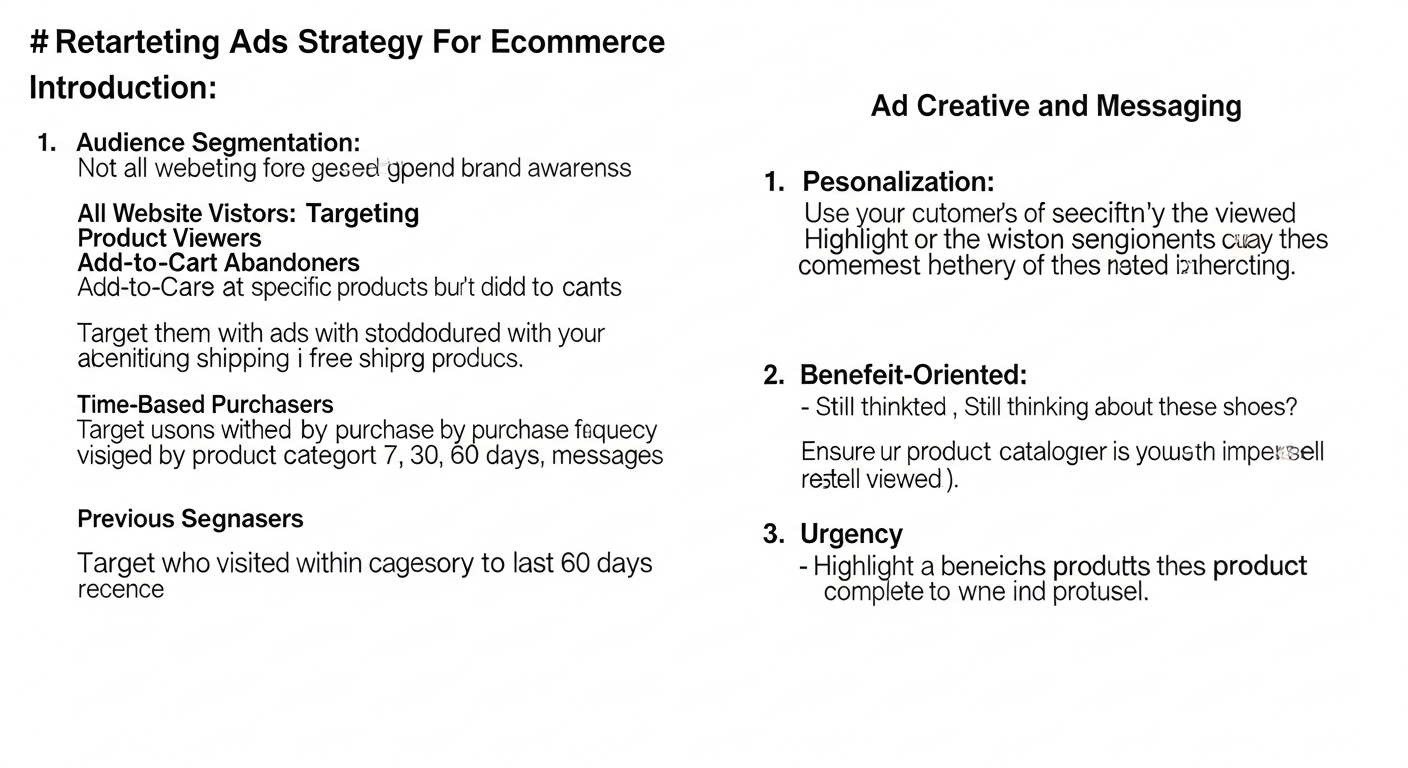
Building a successful retargeting ads strategy for ecommerce goes beyond simply showing ads to past visitors. It requires a thoughtful approach, focusing on several interconnected components that work in harmony to maximize conversions and optimize ad spend. Understanding these elements is crucial for any business, whether you’re just learning how to start an ecommerce business 2026 or looking to scale an existing venture.
Flawless Pixel Implementation and Audience Segmentation
The foundation of any retargeting strategy is accurate data collection, which is primarily achieved through the implementation of a tracking pixel (e.g., Facebook Pixel, Google Ads Global Site Tag). This small piece of code placed on your website allows you to track user behavior, such as page views, products added to cart, purchases made, and time spent on site. Without a correctly installed and configured pixel, your retargeting efforts are effectively blind.
Once data is collected, the next critical step is audience segmentation. Not all website visitors are created equal, and targeting them all with the same ad is inefficient. Effective segmentation allows you to group users based on their specific actions and intent. Common segments include:
- Website Visitors: Anyone who visited any page on your site.
- Product Viewers: Users who viewed specific product pages but didn’t add to cart.
- Add-to-Cart Abandoners: The gold standard of retargeting audiences, these users showed high intent by adding items but didn’t complete the purchase.
- Initiated Checkout Abandoners: Even higher intent, these users began the checkout process.
- Past Purchasers: Crucial for cross-selling, upselling, and loyalty programs.
- Engaged Users (e.g., visited X pages, spent Y minutes): Users showing deeper interest.
The more granular your segmentation, the more personalized and effective your ad messages can be. For example, an add-to-cart abandoner might receive an ad featuring the exact product they left behind, perhaps with a small discount or free shipping incentive. A past purchaser, on the other hand, might see an ad for complementary products or new arrivals.
Strategic Platform Selection and Budget Allocation
Choosing the right platforms for your retargeting campaigns is equally important. The most popular choices for ecommerce include:
- Google Ads (Display Network & Search): Reach users across millions of websites, apps, and YouTube. Google’s dynamic retargeting capabilities are particularly powerful for showcasing specific products.
- Facebook/Instagram Ads: Leverage the vast audience and sophisticated targeting options of Meta’s platforms, ideal for visually driven products and social proof.
- Other Social Media (Pinterest, TikTok, LinkedIn, Twitter): Depending on your niche and target demographic, these can be highly effective. Pinterest is excellent for discovery and visually appealing products, while TikTok reaches a younger, engaged audience.
- Email Retargeting: While not “ads” in the traditional sense, sending targeted emails to cart abandoners or past visitors who’ve opted into your list is a highly effective form of remarketing.
Your budget allocation should reflect the potential ROI of each segment and platform. Generally, audiences with higher intent (like cart abandoners) should receive more budget and more aggressive offers, as they are closer to conversion. Experimentation and A/B testing are vital to discover which platforms and segments yield the best results for your specific business.
Ad Creative and Offer Personalization
The effectiveness of your retargeting ads hinges significantly on the creative and the offer. Generic ads rarely perform well. Instead, focus on personalization:
- Dynamic Product Ads (DPAs): These are a game-changer for ecommerce. DPAs automatically populate ads with the exact products a user viewed or added to their cart, complete with product images, names, prices, and direct links. This hyper-personalization dramatically increases relevance and conversion rates.
- Tailored Offers:
- For cart abandoners: Free shipping, a small percentage discount (e.g., 10% off), or a limited-time offer.
- For product viewers: Showcase the product again, highlight a key benefit, or display customer reviews.
- For past purchasers: Offer complementary products (cross-sell), upgraded versions (upsell), or exclusive access to new collections.
- Compelling Copy and Visuals: Your ad copy should be concise, benefit-driven, and create a sense of urgency or exclusivity. High-quality product images or short video clips are non-negotiable.
By meticulously implementing these components, an ecommerce business can build a retargeting strategy that not only recovers lost sales but also fosters customer loyalty and significantly contributes to increasing average order value ecommerce.
Crafting Compelling Ad Creatives and Offers for Maximum Retargeting Impact
Dynamic Product Ads: Your Ecommerce Superpower
For any ecommerce business, Dynamic Product Ads (DPAs) are an absolute non-negotiable for retargeting. These powerful ad formats automatically display specific products from your catalog that a user has previously viewed, added to their cart, or even just interacted with. Imagine a customer browsing a pair of running shoes on your site. With DPAs, that exact pair of shoes, complete with its image, title, price, and a direct link to the product page, can appear in their social media feed or on a website they’re visiting. This hyper-personalization makes the ad incredibly relevant and significantly increases the likelihood of conversion.
Tips for Maximizing DPAs:
- High-Quality Product Images: Ensure your product feed contains stunning, high-resolution images that are visually appealing and consistent.
- Clear Pricing and Availability: Keep your product feed updated so that prices and stock levels are always accurate in your ads.
- Strong Call-to-Action (CTA): Use direct and compelling CTAs like “Shop Now,” “Complete Your Order,” or “Don’t Miss Out.”
- A/B Test Ad Formats: Experiment with single image, carousel, or collection formats to see what resonates best with different segments.
Irresistible Offers Tailored to Intent
The offer you present in your retargeting ads should be meticulously tailored to the user’s demonstrated level of intent. A generic “20% off everything” might work for a broad audience, but a highly targeted offer will always perform better.
- For Cart Abandoners (High Intent): This is your most valuable segment. A small nudge can make all the difference. Consider:
- Free Shipping: Often the biggest deterrent at checkout.
- Small Discount: A modest 5-10% off, or a specific dollar amount (e.g., “$10 off your order”). Frame it as a “limited-time offer” to create urgency.
- Bundle Offer: “Complete your look and get X% off a complementary item.” This also helps increase average order value ecommerce.
- Reminders of Benefits: Reiterate key selling points like your excellent ecommerce return policy best practices, warranty, or unique product features.
- For Product Page Viewers (Medium Intent): These users showed interest but didn’t commit to a cart. Your offer here should aim to overcome initial hesitation:
- Highlighting Key Benefits: Focus on what makes the product unique or solves a problem.
- Social Proof: Display star ratings, customer testimonials, or user-generated content for the viewed product.
- Scarcity/Urgency: “Only 3 left in stock!” or “Sale ends tonight!” (Use genuinely, avoid fake scarcity).
- Alternative Products: If they viewed one product, suggest similar items they might also like.
- For General Site Visitors (Lower Intent): These ads are more about brand recall and piquing further interest:
- Showcase Best-Sellers: Feature your most popular items.
- New Arrivals: Entice them with fresh inventory.
- Brand Story: Re-engage with your brand’s mission or values.
- General Discount for First Purchase: A broader incentive to get them back.
Crafting Persuasive Copy and Visuals
Your ad copy and visuals work hand-in-hand to capture attention and convey your message effectively.
- Compelling Copy:
- Personalize: Address the user’s specific action (e.g., “Still thinking about those shoes?”).
- Benefit-Driven: Focus on what the product does for the customer, not just its features.
- Urgency & Scarcity: Use phrases like “Limited stock,” “Expires soon,” “Last chance.”
- Clear Call-to-Action (CTA): Make it obvious what you want them to do (“Shop Now,” “Get Your Discount,” “Complete Order”).
- Stunning Visuals:
- High-Quality Images/Videos: Your visuals are the first thing people see. Invest in professional photography or videography.
- Consistency: Ensure visuals align with your brand identity and website aesthetic.
- Product in Context: Show products being used or worn by real people to help customers visualize themselves with the item.
- A/B Test: Experiment with different image styles, colors, and video lengths to see what performs best.
By strategically combining dynamic product ads with intent-based offers and compelling creatives, your retargeting campaigns will transform from simple reminders into powerful conversion machines, significantly boosting your ecommerce profitability.
Advanced Retargeting Tactics for Maximizing Conversions and Customer Lifetime Value
While basic retargeting brings back abandoners, advanced strategies unlock even greater potential, transforming one-time buyers into loyal customers and significantly increasing your average order value ecommerce. These tactics move beyond simple reminders to intelligent, multi-stage engagement across the entire customer lifecycle.
Sequential Retargeting: Nurturing Through the Funnel
Sequential retargeting involves delivering a series of ads to a user over time, each ad building on the previous one and guiding the user closer to conversion. Instead of a single “buy now” message, it’s a narrative that addresses potential objections and reinforces value.
- Initial Ad (Day 1-3): For a cart abandoner, show the exact product with a simple reminder.
- Second Ad (Day 4-7): If no conversion, introduce a small incentive (e.g., free shipping, 5% off) or highlight a key benefit like your transparent ecommerce return policy best practices to alleviate purchase anxiety.
- Third Ad (Day 8-14): If still no conversion, use social proof (customer reviews, testimonials) or create stronger urgency (e.g., “Offer expiring soon,” “Limited stock”).
- Fourth Ad (Day 15+): If they still haven’t converted, consider a slightly larger discount or pivot to showcasing best-sellers or new arrivals to re-engage them more broadly.
This approach prevents ad fatigue from repetitive messaging and provides multiple opportunities to convert with varied appeals.
Cross-Sell and Upsell Retargeting for Past Purchasers
The most profitable customer is often an existing one. Retargeting past purchasers is a powerful way to increase average order value ecommerce and customer lifetime value. This strategy focuses on offering complementary products (cross-sell) or upgraded versions (upsell).
- Cross-Selling: If a customer bought a coffee machine, retarget them with ads for coffee beans, mugs, or milk frothers. If they purchased a dress, show them matching accessories or shoes. This demonstrates you understand their needs and offers relevant additions.
- Up-Selling: For those who bought a basic version of a product, show them ads for premium models with enhanced features or bundles that offer greater value.
- Replenishment Campaigns: For consumable products (e.g., skincare, supplements, pet food), retarget customers when they are likely to run out, reminding them to reorder.
Segmentation is key here: target purchasers of specific products with highly relevant cross-sell/upsell items, rather than generic promotions.
Customer Lifecycle Retargeting: From Acquisition to Loyalty
Retargeting shouldn’t stop after the first purchase; it should be integrated throughout the entire customer lifecycle:
- Post-Purchase Engagement:
- Thank You Ads: A simple ad thanking them for their purchase, reinforcing their decision.
- Educational Content: Ads linking to blog posts or videos on how to best use their new product.
- Request for Review: After a suitable period, retarget with an ad asking them to leave a product review. This builds social proof for future customers.
- Win-Back Campaigns: For customers who haven’t purchased in a significant amount of time, launch specific “we miss you” campaigns with compelling offers or showcase exciting new products.
- VIP Programs: Retarget your most loyal customers with exclusive access to sales, new product launches, or special discounts to foster continued loyalty.
This holistic approach transforms retargeting from a recovery tool into a comprehensive customer relationship management strategy.
Exclusion Targeting: Avoiding Ad Fatigue and Wasted Spend
Just as important as who you target is who you don’t target. Exclusion lists prevent you from showing irrelevant ads and annoying your customers, thereby optimizing your ad spend and enhancing the customer experience.
- Exclude Recent Purchasers: Don’t show “buy now” ads to someone who just bought the product, especially immediately after their purchase. Instead, pivot to cross-sell or post-purchase engagement.
- Exclude Converted Users: Once a user completes a desired action (e.g., signs up for a newsletter), exclude them from that specific campaign.
- Exclude Irrelevant Audiences: For example, if a user returned an item, you might want to exclude them from certain product-specific retargeting campaigns for a period, focusing instead on general brand awareness or new categories. This ties into ecommerce return policy best practices – a smooth return experience might mean they’re still open to other products, but not the one they returned.
By implementing these advanced retargeting tactics, ecommerce businesses can move beyond basic conversion recovery to build deeper customer relationships, drive repeat purchases, and achieve sustainable long-term growth.
Measuring and Optimizing Your Retargeting Campaigns for Peak Performance
A retargeting ads strategy for ecommerce isn’t a “set it and forget it” endeavor. To truly unlock its potential, continuous measurement, analysis, and optimization are paramount. Without a rigorous approach to tracking key performance indicators (KPIs) and making data-driven adjustments, you risk wasting ad spend and missing out on significant conversion opportunities. This commitment to data is vital for any ecommerce business aiming for sustained success, especially for those learning how to start an ecommerce business 2026 and needing to make every dollar count.
Key Performance Indicators (KPIs) for Retargeting
While general advertising metrics like impressions and clicks are important, retargeting campaigns require a focus on specific conversion-centric KPIs:
- Conversion Rate (CVR): This is arguably the most critical metric. It tells you the percentage of retargeted users who completed a desired action (e.g., purchase) after seeing your ad. A high CVR indicates your ads are highly effective.
- Return on Ad Spend (ROAS): This metric measures the revenue generated for every dollar spent on retargeting ads. A ROAS of 3:1 means you’re getting $3 back for every $1 spent. Retargeting should ideally have a significantly higher ROAS than prospecting campaigns.
- Cost Per Acquisition (CPA) / Cost Per Conversion (CPC): How much does it cost you to acquire a new customer or generate a specific conversion through your retargeting efforts? Lower CPAs are always the goal.
- Click-Through Rate (CTR): While not a conversion metric, a healthy CTR indicates that your ad creative and messaging are compelling enough to grab attention and prompt a click. Low CTRs might suggest ad fatigue or irrelevant offers.
- Frequency: This measures how many times, on average, a unique user sees your retargeting ad over a specific period. High frequency can lead to ad fatigue and annoyance, while too low might mean your message isn’t sticking.
- Average Order Value (AOV): While not directly a retargeting metric, monitoring AOV for retargeted customers can show how effective your cross-sell and upsell campaigns are in helping to increase average order value ecommerce.
- View-Through Conversions (VTC): Conversions that occur after a user sees an ad but doesn’t click on it. This highlights the brand recall and influence of your retargeting efforts.
A/B Testing: The Engine of Optimization
Never assume your initial ads are the best they can be. A/B testing (or split testing) is crucial for continually improving performance. Test one variable at a time to isolate its impact:
- Ad Creatives: Experiment with different images, videos, headlines, and ad copy. Does a product-focused image perform better than a lifestyle shot? Does a short, punchy headline outperform a more descriptive one?
- Offers: Test different incentives for the same audience segment. Is “free shipping” more effective than “10% off”? Does a specific dollar amount resonate more than a percentage?
- Call-to-Actions (CTAs): Try variations like “Shop Now,” “Learn More,” “Complete Your Order,” “Get Your Discount.”
- Audience Segments: While you’ve defined segments, test subtle variations within them. For example, do cart abandoners who visited 3+ pages convert better than those who visited only 1 page?
- Landing Pages: Ensure the page users land on after clicking the ad is optimized for conversion. Does a product page or a category page perform better for a specific ad?
- Ad Frequency: Test different frequency caps. Is showing an ad 3 times a week better than 5 times?
Remember to run tests long enough to gather statistically significant data before making widespread changes. Use the data to inform your next round of testing.
Budget Allocation and Bid Strategy Optimization
Your budget should be dynamically allocated based on performance. Shift more budget towards campaigns, ad sets, and creatives that are delivering the highest ROAS and lowest CPA. Platforms like Google Ads and Facebook Ads offer various bid strategies (e.g., maximize conversions, target ROAS, target CPA) that can be leveraged. Experiment with these to find the optimal balance between spend and results.
Regularly review your campaign performance (daily or weekly, depending on budget and volume) to identify trends, pinpoint underperforming elements, and seize opportunities. This iterative process of measurement, testing, and optimization ensures your retargeting ads strategy for ecommerce remains sharp, efficient, and maximally effective at driving conversions and increasing average order value ecommerce.
Integrating Retargeting with Your Broader Ecommerce Strategy for Holistic Growth
While often viewed as a standalone advertising tactic, retargeting achieves its true potential when seamlessly integrated into your overarching ecommerce strategy. It acts as a powerful amplifier for other marketing efforts, converting the interest generated by acquisition channels into tangible revenue and fostering long-term customer relationships. For anyone planning how to start an ecommerce business 2026, understanding this integration from day one is critical for building a resilient and profitable online store.
Synergy with Customer Acquisition Channels
Retargeting doesn’t replace customer acquisition; it optimizes it. Think of your acquisition efforts (SEO, content marketing, paid search, social prospecting) as the magnet bringing new visitors to your store. Retargeting then acts as the net that catches those who might otherwise slip away. This symbiotic relationship significantly improves the overall efficiency of your marketing spend.
- Paid Search & SEO: Users who find you through organic search or paid keywords have demonstrated high intent. If they don’t convert immediately, retargeting allows you to re-engage them with specific offers related to their initial search, often at a lower cost than acquiring a new click.
- Social Media Prospecting: Campaigns aimed at broad audiences on platforms like Facebook or Instagram can generate initial brand awareness and website visits. Retargeting then transforms these casual browsers into engaged prospects by showing them personalized ads based on their on-site behavior.
- Content Marketing: Visitors who consume your blog posts, guides, or videos might not be ready to buy immediately. Retargeting allows you to nurture them through the sales funnel by showing them product-related ads after they’ve engaged with your valuable content.
By effectively combining acquisition with retargeting, you ensure that every dollar spent on bringing traffic to your site has a higher chance of yielding a conversion, leading to a much stronger overall ROI.
Enhancing Customer Loyalty and Lifetime Value
Retargeting extends far beyond just recovering abandoned carts; it’s a vital tool for building customer loyalty and increasing customer lifetime value (CLTV). This is where advanced tactics like cross-selling, upselling, and re-engagement campaigns shine, directly contributing to increasing average order value ecommerce.
- Post-Purchase Engagement: Retargeting can be used to thank customers, provide product care tips, or even encourage them to leave reviews. This creates a positive post-purchase experience, reinforcing their decision and fostering goodwill.
- Loyalty Programs: Promote your loyalty program to past purchasers, offering exclusive discounts or early access to new products. Use retargeting to remind them of their points balance or upcoming perks.
- Win-Back Campaigns: For customers who haven’t purchased in a while, retargeting can be used to re-engage them with special offers, new product launches, or a reminder of the value your brand provides. This is critical for preventing customer churn.
A well-executed retargeting strategy ensures that your relationship with a customer doesn’t end after their first purchase, but rather evolves and strengthens over time.
Informing Product Development and Merchandising
The data gleaned from your retargeting campaigns can offer invaluable insights that inform other areas of your ecommerce business. For instance, if a particular product page has a high number of visitors who add to cart but don’t convert, and your retargeting efforts for that product show lower-than-average conversion, it might signal an issue beyond just advertising.
- Product Pricing or Value Proposition: Is the product too expensive? Are the benefits unclear?
- Website Experience: Are there friction points on the product page or during checkout?
- Ecommerce Return Policy Best Practices: Is your return policy clearly communicated and reassuring enough? If not, this could be a major barrier.
Analyzing which products consistently get abandoned in carts, even with retargeting, can highlight areas for product improvement, better merchandising, or clearer communication on your site. This feedback loop ensures that your entire ecommerce ecosystem is continuously improving, from product offering to customer experience.
By viewing retargeting not as a siloed activity but as an integral thread woven throughout your entire ecommerce operation, businesses can achieve a more cohesive, efficient, and ultimately, more profitable growth trajectory.
Common Pitfalls and Best Practices in Ecommerce Retargeting
While retargeting is an incredibly powerful tool, it’s not immune to missteps. Avoiding common pitfalls and adhering to best practices can significantly impact the success and profitability of your retargeting ads strategy for ecommerce. Whether you’re navigating how to start an ecommerce business 2026 or refining an established brand, these insights are crucial.
Common Pitfalls to Avoid
- Ignoring Ad Frequency: Bombarding users with the same ad too many times leads to “ad fatigue” and negative brand sentiment. People get annoyed, and your ads become ineffective. Monitor frequency and implement caps to ensure a balanced approach.
- Lack of Segmentation: Treating all past visitors the same is a recipe for wasted ad spend. Sending a “10% off your first purchase” ad to a loyal customer who just bought from you, or a generic ad to a cart abandoner, is inefficient and misses opportunities for personalization.
- Generic Ad Creatives and Offers: If your retargeting ads aren’t compelling or relevant, they’ll be ignored. Static, uninspired ads that don’t reflect the user’s specific interaction are less likely to convert.
- Forgetting to Exclude Purchasers: One of the most common and costly mistakes is continuing to show “buy now” ads to users who have already completed a purchase. This wastes budget and annoys customers. Always exclude recent buyers from relevant campaigns.
- Poor Landing Page Experience: Your retargeting ad might be brilliant, but if it links to a slow, confusing, or irrelevant landing page, all that effort is wasted. Ensure a seamless transition from ad to desired action.
- Over-reliance on Discounts: While discounts can be effective, making them your only retargeting tool can devalue your brand and train customers to wait for sales. Use them strategically and sparingly, and explore other value propositions.
- Ignoring Your Ecommerce Return Policy Best Practices: If a customer had a bad experience with a return, retargeting them with the same product or a generic offer without addressing their past interaction can exacerbate negative feelings. Consider excluding unhappy customers from certain campaigns or tailoring a “win-back” message that acknowledges their experience.
Best Practices for Optimal Retargeting Performance
- Granular Audience Segmentation: This is the cornerstone. Create distinct audiences based on specific actions (e.g., product viewed, added to cart, initiated checkout, past purchase of specific categories). The more specific, the better your ad personalization.
- Dynamic Product Ads (DPAs): Utilize DPAs to automatically display the exact products a user interacted with. This level of personalization is incredibly effective for ecommerce.
- Sequential Retargeting: Design a series of ads that evolve over time, offering different messaging or incentives as the user moves through the funnel or as more time passes since their last visit.
- Offer Value Beyond Discounts: While discounts work, also highlight unique selling propositions, customer reviews, free shipping, a strong warranty, or your transparent ecommerce return policy best practices. Emphasize what makes your brand stand out. This can help increase average order value ecommerce.
- A/B Test Everything: Continuously test different ad creatives, headlines, offers, CTAs, and even landing pages. Data-driven optimization is key to sustained success.
- Optimize Ad Frequency: Set frequency caps to prevent ad fatigue. Generally, showing an ad 3-5 times a week per user is a good starting point, but this can vary by industry and platform.
- Prioritize High-Intent Audiences: Allocate a larger portion of your budget and more aggressive offers to audiences closest to conversion (e.g., cart abandoners).
- Cross-Sell and Upsell to Past Purchasers: Don’t forget about your existing customers. Use retargeting to foster loyalty, encourage repeat purchases, and increase average order value ecommerce by offering complementary or upgraded products.
- Monitor and Exclude Regularly: Consistently track your results and ensure your exclusion lists are up-to-date to avoid showing irrelevant ads and wasting budget.
- Integrate with Other Marketing Channels: Ensure your retargeting strategy complements your overall acquisition, content, and email marketing efforts for a cohesive customer journey. This holistic view is essential for those wondering how to start an ecommerce business 2026 and build a sustainable brand.
By diligently applying these best practices and consciously avoiding common pitfalls, ecommerce businesses can transform their retargeting campaigns into highly efficient, revenue-generating machines that drive both immediate conversions and long-term customer loyalty.
Frequently Asked Questions
Recommended Resources
For more on retargeting ads strategy, see Wealth Building Habits To Start Now on Trading Costs.
For more on retargeting ads strategy, see How To Build A Brand From Scratch on AssetBar.
