
Shopify vs. BigCommerce vs. Magento: The Ultimate E-commerce Platform Showdown for D2C Growth in 2026
Affiliate disclosure: This article may contain affiliate links. Recommendations are independent and editorially driven.
In the relentless pursuit of direct-to-consumer (D2C) growth and online store profitability, selecting the right e-commerce platform isn’t merely a technical decision—it’s a strategic imperative. Your choice dictates everything from your operational agility and conversion rates to your long-term scalability and total cost of ownership. For businesses aiming to thrive in the competitive digital landscape of 2026 and beyond, understanding the nuances between the industry’s titans—Shopify, BigCommerce, and Magento—is paramount.
These three platforms represent distinct philosophies in e-commerce infrastructure, each catering to different business sizes, technical capabilities, and growth aspirations. Shopify champions simplicity and speed-to-market, BigCommerce offers a robust SaaS solution balancing ease of use with powerful features, and Magento (now largely bifurcated into the open-source Magento Open Source and the enterprise-grade Adobe Commerce) provides unparalleled flexibility and control for those with significant development resources.
This comprehensive guide from e-comprofits delves deep into the core functionalities, underlying architectures, cost implications, and strategic advantages of Shopify vs BigCommerce vs Magento. Our goal is to equip you with the insights needed to make an informed decision that aligns with your D2C growth objectives, optimizes your conversion funnels, and secures your online store’s profitability for years to come.
The E-commerce Powerhouses: An Overview of Each Platform
Before diving into a granular comparison, it’s essential to grasp the fundamental positioning and philosophy of each platform. While all three facilitate online sales, their approaches to empowering merchants vary significantly.
Shopify: The SaaS Simplicity King for D2C Brands
Shopify has cemented its reputation as the go-to platform for entrepreneurs, small to medium-sized businesses (SMBs), and rapidly growing D2C brands seeking a powerful yet user-friendly solution. As a fully hosted, software-as-a-service (SaaS) platform, Shopify handles all the technical complexities of hosting, security, and maintenance. This allows merchants to focus almost entirely on product, marketing, and customer experience—the true drivers of D2C growth.
Its intuitive interface, extensive app store, and integrated payment processing (Shopify Payments) mean businesses can launch quickly, iterate efficiently, and scale without needing deep technical expertise. While celebrated for its ease of use, Shopify has also evolved to support larger enterprises with its advanced Shopify Plus offering, bridging the gap between simplicity and enterprise-grade needs.
BigCommerce: The Scalable SaaS Alternative for Growth-Focused Businesses
BigCommerce positions itself as a robust, enterprise-ready SaaS solution designed for businesses experiencing significant growth and those with more complex needs than typical SMBs. It offers a powerful feature set out-of-the-box, aiming to reduce reliance on third-party apps compared to some competitors. Like Shopify, BigCommerce is fully hosted, meaning it manages server maintenance, security, and updates, freeing merchants from technical overhead.
BigCommerce excels in providing advanced B2B functionalities, comprehensive SEO tools, and powerful multi-channel selling capabilities. Its focus on providing a strong native feature set appeals to merchants who want fewer integrations and a more consolidated platform experience. It’s often chosen by businesses that have outgrown simpler platforms or are looking for a SaaS solution with greater inherent flexibility for customization and integrations, particularly for larger product catalogs or complex pricing structures.
Magento (Adobe Commerce / Open Source): The Open-Source Powerhouse for Unrivaled Control
Magento stands apart as an open-source e-commerce platform renowned for its immense flexibility, customization potential, and scalability. Historically, “Magento” referred to both its free open-source version (now Magento Open Source) and its paid enterprise version (formerly Magento Enterprise Edition, now Adobe Commerce). For the purpose of this comparison, when we refer broadly to Magento, we acknowledge both facets, though their implications for businesses differ.
Magento Open Source is free to download and use, but merchants are responsible for all hosting, security, maintenance, and development costs. This requires significant technical expertise, either in-house or through a dedicated development agency. Adobe Commerce, on the other hand, is a premium, licensed version that includes enhanced features, dedicated support, and advanced cloud hosting, primarily targeting large enterprises with complex operational requirements.
The core appeal of Magento lies in its limitless customization. Businesses can modify virtually every aspect of their store, integrate with any system, and build highly unique functionalities. This level of control is invaluable for brands with highly specific business logic, complex integrations, or unique customer experiences that simply cannot be achieved with off-the-shelf SaaS solutions. However, this power comes with a higher total cost of ownership (TCO) and a steeper learning curve, making it suitable for businesses with substantial budgets and development resources.
Core E-commerce Features and Storefront Capabilities
The heart of any e-commerce platform lies in its ability to facilitate seamless transactions and present products effectively. Let’s dissect how Shopify, BigCommerce, and Magento stack up in terms of their fundamental e-commerce feature sets.
Product Management & Catalog Features
Shopify: Offers intuitive product management designed for ease of use. Merchants can quickly add products, variants, images, descriptions, and SEO details. Its native support for digital products, subscriptions (via apps), and dropshipping makes it versatile. However, for extremely large catalogs (millions of SKUs) or highly complex product configurations, businesses might find themselves relying heavily on third-party apps or custom development, especially if specific B2B features like tiered pricing or customer-group specific catalogs are needed without Shopify Plus.
BigCommerce: Excels in handling large and complex product catalogs right out of the box. It boasts robust features for product options (e.g., size, color, material) with extensive variant management, custom fields, and native B2B capabilities such as customer groups, tiered pricing, and quoting tools. BigCommerce is often favored for its ability to manage extensive inventory and detailed product information without immediate recourse to numerous apps. Its bulk editing tools are also quite powerful for managing large data sets.
Magento: Provides the most comprehensive and flexible product management system. It supports an almost infinite number of products, attributes, and complex product types (simple, configurable, bundled, grouped, virtual, downloadable). Its attribute sets allow for highly detailed product data, crucial for niche markets or highly specific product categories. Magento’s strength here is its ability to model virtually any product structure, making it ideal for unique business requirements, although this power requires a deeper understanding of its architecture.
Checkout Experience & Payment Gateways
Shopify: Famous for its streamlined, high-converting one-page checkout. Shopify Payments is natively integrated, offering competitive transaction rates and simplifying PCI compliance. Merchants can also integrate with a vast array of third-party payment gateways. Customization of the checkout page itself is highly restricted on standard Shopify plans for security and conversion optimization reasons, though Shopify Plus offers more flexibility for branding and minor functional tweaks.
BigCommerce: Offers a highly customizable one-page checkout experience. It supports integration with over 65 pre-integrated payment gateways worldwide, providing merchants with significant choice and often lower transaction fees than Shopify’s default. BigCommerce’s checkout can be customized via its Checkout SDK (Software Development Kit) or by leveraging headless commerce approaches, offering more control than standard Shopify plans while maintaining PCI compliance.
Magento: Offers unparalleled flexibility in designing and customizing the checkout process. Developers can completely re-engineer the checkout flow, integrate any payment gateway, and implement complex custom logic. This power is a double-edged sword: while it allows for highly optimized and unique checkouts, it also means significant development effort and ongoing maintenance to ensure security and functionality. PCI compliance becomes a shared responsibility, demanding careful implementation.
Theme & Design Flexibility
Shopify: Offers a wide selection of beautiful, mobile-responsive themes (both free and paid) through its Theme Store. These themes are generally easy to customize using a drag-and-drop editor and can be further tailored with HTML/CSS/Liquid code for those with basic development skills. While highly functional and aesthetically pleasing, deep structural changes or highly unique designs often require custom theme development or extensive app usage, which can sometimes lead to code bloat if not managed well.
BigCommerce: Provides a robust theme framework with Stencil, its modern theme engine. Merchants have access to a variety of free and paid themes that are generally well-coded and offer extensive customization options via its visual editor and template files. BigCommerce themes are known for being highly performant and SEO-friendly. The platform also offers greater access to template files and front-end code than standard Shopify, allowing for more comprehensive design modifications without going fully headless.
Magento: Offers the ultimate in design freedom. With its open-source nature, developers can build entirely custom themes from scratch or heavily modify existing ones. This allows for virtually any visual design or user experience imaginable. However, developing a high-quality Magento theme requires significant expertise in Magento’s templating system (XML, PHTML, CSS, JavaScript) and often a substantial budget. This flexibility is a key differentiator for brands requiring a highly unique and branded storefront.
Multi-channel & Headless Commerce Capabilities
Shopify: Has strong native multi-channel capabilities, integrating seamlessly with social media channels (Facebook, Instagram, Pinterest), online marketplaces (Amazon, eBay), and even physical retail with Shopify POS. Shopify is also a leader in headless commerce, offering robust APIs (Storefront API, Admin API) that allow merchants to use Shopify as a backend while powering their storefronts with custom front-end technologies (e.g., React, Vue, Next.js). Shopify Plus specifically shines here, providing even greater API access and support for complex headless implementations.
BigCommerce: Offers powerful multi-channel selling features, including integrations with Amazon, eBay, Google Shopping, Facebook, and Instagram. Its native integrations are often praised for their depth and ease of management. BigCommerce is also a strong contender in the headless commerce space, actively promoting its API-first architecture. Its Stencil CLI and various SDKs make it relatively straightforward for developers to build custom front-ends, positioning it as a highly flexible backend for diverse digital experiences.
Magento: Being open-source and API-driven from its inception, Magento has always been a natural fit for multi-channel and headless commerce. Its comprehensive APIs allow it to serve as the commerce engine for virtually any front-end application, including custom websites, mobile apps, IoT devices, and even smart mirrors. This makes Magento ideal for businesses looking to create truly bespoke omnichannel experiences or integrate deeply with complex enterprise systems. However, implementing headless commerce with Magento requires significant development expertise and architectural planning.
[INLINE IMAGE 1: place after second H2 | alt=”shopify vs bigcommerce vs magento concept illustration”]
Performance, Scalability, and Hosting Infrastructure
For any D2C brand focused on conversion and growth, the underlying infrastructure that powers your store is as critical as its features. Site speed, uptime, and the ability to handle traffic spikes directly impact customer experience, SEO rankings, and ultimately, your bottom line.
Hosting & Uptime Guarantees
Shopify: As a fully hosted SaaS platform, Shopify handles all server infrastructure, security patches, and maintenance. This translates to incredibly high uptime (often 99.98% or higher) and fast global content delivery via its robust CDN. Merchants don’t need to worry about server management, backups, or security updates. This “set it and forget it” hosting model is a huge draw for businesses without dedicated IT teams, allowing them to focus on marketing and sales.
BigCommerce: Also a fully hosted SaaS solution, BigCommerce provides enterprise-grade hosting, security, and CDN services. It boasts similar high uptime guarantees to Shopify and ensures a fast, reliable experience for merchants and customers worldwide. Like Shopify, the responsibility for infrastructure management rests entirely with BigCommerce, simplifying operations for D2C brands. They leverage Google Cloud Platform and other advanced technologies to ensure peak performance and stability.
Magento: Since Magento Open Source is self-hosted, the merchant is entirely responsible for choosing and managing their hosting provider. This offers maximum control but also comes with the significant responsibility of ensuring high uptime, security, and performance. Dedicated servers, cloud hosting (AWS, Google Cloud, Azure), or specialized Magento hosting providers are typically required for optimal performance, especially for growing businesses. Adobe Commerce, conversely, includes cloud hosting as part of its enterprise package, significantly reducing the operational burden for larger businesses that opt for this version, providing a managed, high-performance environment.
Scalability for Growth Surges
Shopify: Designed to scale from a single-product startup to a multi-million dollar enterprise (with Shopify Plus). Its SaaS architecture is inherently scalable, automatically handling increases in traffic, transactions, and product catalog size. Shopify Plus, in particular, offers dedicated support, higher API limits, and customizable checkout features specifically tailored for high-volume merchants, ensuring smooth operation during peak seasons like Black Friday/Cyber Monday.
BigCommerce: Built for scalability from the ground up, BigCommerce can effortlessly handle significant traffic spikes and large transaction volumes. Its architecture is designed to grow with businesses, supporting extensive product catalogs and complex operational needs without requiring merchants to upgrade their hosting infrastructure. BigCommerce often emphasizes its ability to maintain performance even as a business expands rapidly, a critical factor for D2C brands aiming for aggressive growth without replatforming headaches.
Magento: Magento is arguably the most scalable platform technically, capable of supporting the largest enterprises with billions in revenue. However, achieving optimal scalability with Magento Open Source requires significant investment in infrastructure, skilled developers, and ongoing optimization. This involves careful server configuration, caching strategies, database optimization, and potentially sharding. Adobe Commerce simplifies this by providing a managed, cloud-based solution that is pre-optimized for enterprise-level performance and scalability, significantly easing the burden on merchants.
Site Speed & Performance Optimization
Shopify: Generally offers good out-of-the-box performance due to its optimized infrastructure and CDN. However, site speed can be impacted by heavily customized themes, excessive app usage, and large, unoptimized images. Shopify provides tools and recommendations for optimization, but ultimate control over core page load speeds can be somewhat limited compared to self-hosted solutions. For most D2C brands, its speed is more than adequate, contributing positively to conversion rates.
BigCommerce: Known for its strong out-of-the-box performance, often leveraging advanced technologies like Akamai CDN and Google Cloud Platform. Its Stencil framework is designed with performance in mind, and the platform actively works to ensure themes and assets load quickly. Like Shopify, performance can be affected by unoptimized content or overly complex theme customizations, but BigCommerce generally provides a fast foundation crucial for SEO and user experience.
Magento: Performance with Magento is entirely dependent on the quality of hosting, development, and ongoing optimization. A poorly configured Magento store can be notoriously slow, leading to high bounce rates and poor SEO. Conversely, a well-optimized Magento store, utilizing full page caching (FPC), Varnish, Redis, strong CDN integration, and clean code, can be exceptionally fast. This demands a proactive approach to performance management and significant technical expertise. Adobe Commerce includes many performance optimizations natively and benefits from managed cloud infrastructure, making it easier to achieve high speeds.
Understanding Pricing Models and Total Cost of Ownership (TCO)
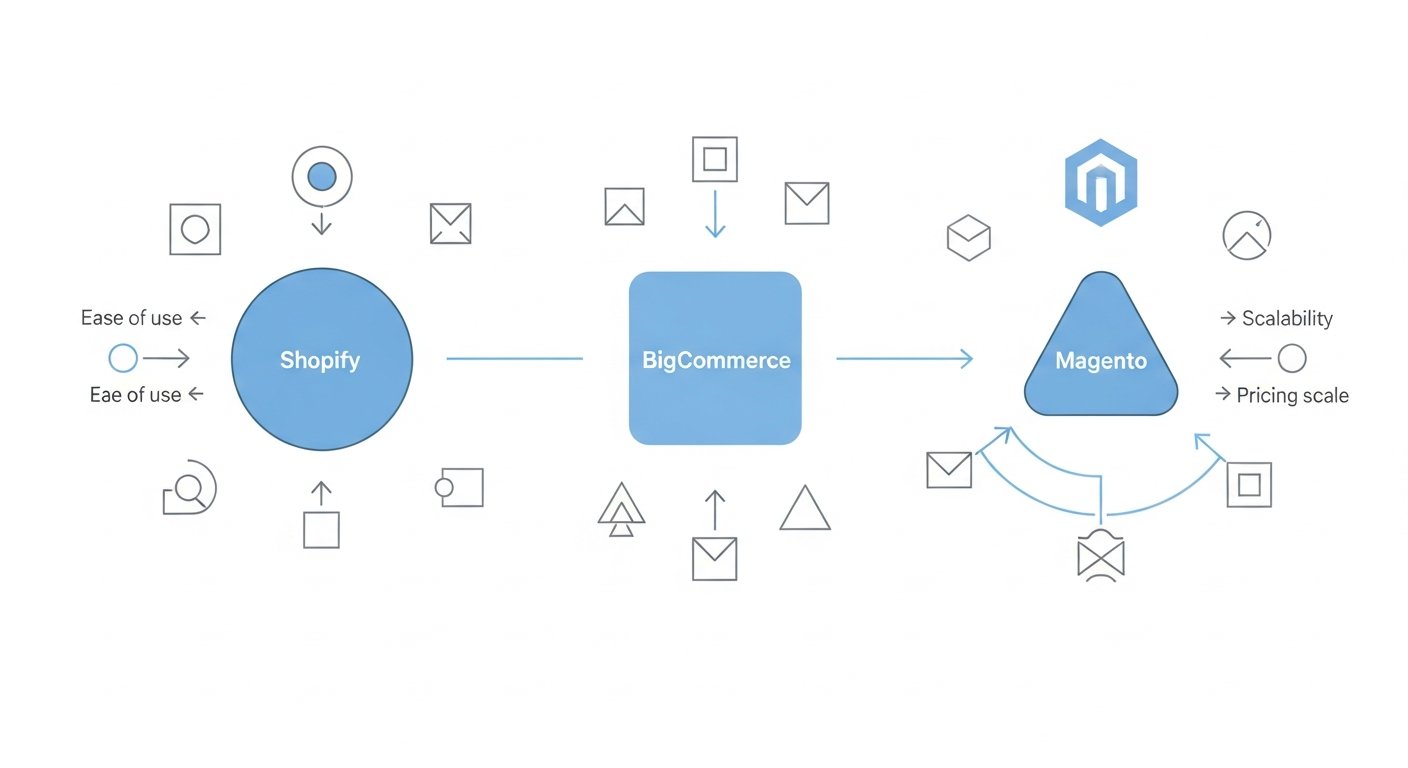
Beyond monthly subscriptions, the true cost of an e-commerce platform encompasses a myriad of factors, including transaction fees, app expenses, development, hosting, and ongoing maintenance. Understanding the Total Cost of Ownership (TCO) is crucial for D2C brands to project profitability accurately.
Shopify’s Subscription Tiers & Transaction Fees
Shopify operates on a tiered subscription model, ranging from Basic Shopify for small businesses to Shopify Plus for enterprises.
- Subscription Fees: Monthly fees vary based on the plan chosen, offering different features, staff accounts, and reporting capabilities.
- Transaction Fees: If you use a third-party payment gateway instead of Shopify Payments, Shopify levies a transaction fee (e.g., 0.5% – 2.0%) depending on your plan. Using Shopify Payments eliminates these additional transaction fees, making it a cost-effective choice for many.
- Apps & Themes: While there are free apps and themes, most powerful extensions and premium themes come with recurring monthly fees or one-time purchases, adding to the TCO.
- Development Costs: For basic setups, development costs are low. For custom theme work, unique functionalities, or headless implementations, development costs can range from a few thousand to hundreds of thousands of dollars, particularly for Shopify Plus projects.
BigCommerce’s Revenue-Tiered Pricing
BigCommerce also uses a subscription model, but its tiers are largely dictated by annual sales volume. As your store’s revenue grows, you are automatically upgraded to a higher plan with more features but also a higher monthly fee.
- Subscription Fees: Monthly fees increase with your annual revenue thresholds. This means a successful store will naturally incur higher platform costs.
- Transaction Fees: Unlike Shopify, BigCommerce does not charge additional transaction fees for using third-party payment gateways (beyond what the gateway itself charges). This can be a significant cost saving for high-volume merchants who prefer not to use the native payment solution.
- Apps & Themes: Similar to Shopify, apps and premium themes contribute to the overall cost. BigCommerce often boasts a more robust native feature set, potentially reducing reliance on some apps compared to Shopify, but key integrations still require them.
- Development Costs: Generally comparable to Shopify for standard setups, with custom theme development or complex integrations requiring professional developers. Headless projects on BigCommerce can also involve substantial development investment.
Magento’s Licensing, Hosting, and Development Costs
Magento’s cost structure is fundamentally different due to its open-source nature and enterprise offering.
- Magento Open Source: The platform itself is free. However, the TCO can be substantially higher due to:
- Hosting: You must purchase and manage your own hosting, which can range from hundreds to thousands of dollars per month depending on traffic and complexity.
- Development: This is the largest component of Magento Open Source TCO. Expect to invest significant capital in theme development, custom module creation, integrations, and ongoing maintenance, often ranging from tens of thousands to hundreds of thousands of dollars for a complex build.
- Extensions: While there’s a large marketplace, quality extensions often come with one-time or recurring fees.
- Security & Maintenance: Ongoing costs for security patching, performance optimization, and version upgrades are substantial and require expert developers.
- Adobe Commerce: This is a premium, licensed product with a considerably higher entry point.
- Licensing Fees: Adobe Commerce licenses are typically negotiated annually and depend on factors like gross merchandise value (GMV) and average order value (AOV). These can range from tens of thousands to hundreds of thousands of dollars per year.
- Hosting: Managed cloud hosting is typically included as part of the Adobe Commerce license, reducing infrastructure concerns.
- Development: While some features are included, custom development for themes, specific functionalities, and integrations remains a significant investment, often even higher than Open Source due to the complexity and enterprise-grade requirements.
- Support: Includes dedicated support from Adobe, a major advantage for large enterprises.
Hidden Costs and Long-Term Investments
Regardless of the platform, D2C brands must factor in common hidden costs:
- Payment Processing Fees: All platforms incur fees from payment gateways (e.g., Stripe, PayPal, Authorize.net).
- Marketing Tools: Email marketing, CRM, analytics, and advertising tools are essential and usually come with separate costs.
- SEO & Content Marketing: Investment in content creation, link building, and ongoing SEO optimization is crucial.
- Shipping & Fulfillment: Costs associated with logistics, shipping labels, and potentially third-party fulfillment services.
- Customer Service: Tools and personnel for customer support.
- Migrations: Replatforming is a complex and costly endeavor. Choosing correctly upfront can save significant future expense.
Here’s a simplified comparison of TCO considerations:
| Feature/Cost Factor | Shopify (Standard/Plus) | BigCommerce (Standard/Enterprise) | Magento Open Source / Adobe Commerce |
|---|---|---|---|
| Platform Fee | Monthly subscription based on plan | Monthly subscription based on revenue tiers | Free (Open Source) / Annual License (Adobe Commerce) |
| Transaction Fees (Non-native) | 0.5% – 2.0% (waived with Shopify Payments) | 0% (beyond gateway fees) | 0% (beyond gateway fees) |
| Hosting & Infrastructure | Included (SaaS) | Included (SaaS) | Self-managed (high cost) / Included (Adobe Commerce) |
| Initial Development | Low-Moderate (basic) / High (custom, Plus) | Low-Moderate (basic) / High (custom, headless) | High-Very High (custom, complex integrations) |
| Ongoing Maintenance/Updates | Managed by Shopify (SaaS) | Managed by BigCommerce (SaaS) | High (self-managed) / Included (Adobe Commerce) |
| App/Extension Costs | Moderate-High (recurring) | Moderate-High (recurring) | Moderate-High (one-time/recurring for quality extensions) |
| Security & Compliance | Managed by Shopify (PCI DSS Level 1) | Managed by BigCommerce (PCI DSS Level 1) | Self-managed (significant investment) / Managed (Adobe Commerce) |
| Support Level | 24/7 (email, chat, phone) / Dedicated (Plus) | 24/7 (email, chat, phone) / Priority (Enterprise) | Community (Open Source) / Dedicated (Adobe Commerce) |
[INLINE IMAGE 2: place after fourth H2 | alt=”shopify vs bigcommerce vs magento comparison illustration”]
Customization, Flexibility, and Developer Ecosystem
The ability to customize your store’s look, feel, and functionality is paramount for D2C brands looking to create unique customer experiences and integrate with specific business processes. This is where the differences between SaaS and open-source models become most apparent.
Theme Customization & Code Access
Shopify: Offers theme customization primarily through its Liquid templating language and theme editor. Merchants can adjust colors, fonts, layouts, and add sections with relative ease. For deeper customization, developers can access and modify the Liquid files, HTML, CSS, and JavaScript. However, direct server access or fundamental changes to Shopify’s core code are not possible. Shopify Plus provides some additional flexibility, particularly with the checkout.liquid file.
BigCommerce: Provides more direct access to theme files and underlying code than standard Shopify plans. Its Stencil theme framework is based on Handlebars.js and allows developers significant control over the front-end presentation. Merchants can modify theme files via the web interface or using the Stencil CLI for local development. This level of access enables more profound design and functional changes while still benefiting from the SaaS infrastructure.
Magento: Offers unparalleled customization capabilities. Being open-source, developers have full access to the entire codebase, database, and server environment. This means every aspect of the storefront, backend, and core functionality can be modified, extended, or replaced. This freedom allows for truly bespoke e-commerce experiences and integration with highly specific business logic. However, this level of control demands highly skilled developers and a rigorous approach to development best practices to avoid breaking core functionality or complicating future upgrades.
API Capabilities for Integrations
Shopify: Boasts a comprehensive and well-documented set of APIs (Admin API, Storefront API, GraphQL API) that allow for extensive integrations with third-party systems like ERPs, CRMs, marketing automation, and custom applications. Its API limits are generally generous for most businesses, with Shopify Plus offering even higher thresholds and dedicated API support. This strong API infrastructure makes Shopify a solid choice for businesses looking to build a composable commerce stack.
BigCommerce: Also offers a robust and well-documented API architecture. Its API-first approach means that virtually every feature on the platform is accessible via API, making it highly flexible for integrations and headless commerce implementations. BigCommerce’s APIs are designed for scalability and performance, supporting complex data synchronization and real-time interactions with external systems. It’s a strong contender for businesses needing deep, reliable integrations without the burden of managing server infrastructure.
Magento: Possesses a powerful and extensive set of APIs that allow for virtually any integration imaginable. Given its open-source nature, developers can not only use the existing APIs but also create custom APIs to expose specific data or functionality. This level of API extensibility is crucial for enterprises with complex IT ecosystems, requiring deep synchronization with legacy systems, custom order management flows, or specialized data analytics platforms. The flexibility is immense, but implementing and managing these integrations requires substantial development effort.
Developer Community & Resources
Shopify: Has a massive and active developer community. The Shopify Developer documentation is excellent, and there are countless tutorials, forums, and agencies specializing in Shopify development. This vibrant ecosystem means finding support, resources, and skilled developers is relatively easy, contributing to faster development cycles and lower overall development risk for many projects. The Shopify Partner Program also fosters a robust network of experts.
BigCommerce: Has a growing and increasingly active developer community. Its developer documentation is comprehensive, covering API usage, theme development with Stencil, and app creation. While perhaps not as vast as Shopify’s, the BigCommerce developer ecosystem is mature and well-supported, with ample resources available for custom development and integrations. BigCommerce actively invests in its developer tools and community engagement.
Magento: Boasts one of the largest and most established open-source developer communities in the e-commerce world. With thousands of developers globally, finding expertise is possible, but the complexity of the platform often means specialized and highly experienced developers are required. While extensive documentation and community forums exist, the learning curve is steep, and the cost of hiring top-tier Magento talent can be substantial. For Adobe Commerce users, additional resources and direct support from Adobe’s network are available.
Learn more about the benefits of headless commerce for D2C brands.
Apps, Integrations, and the E-commerce Ecosystem
No single e-commerce platform can provide every conceivable feature out-of-the-box. The strength of a platform’s ecosystem—its app store, native integrations, and partner network—is vital for extending functionality, streamlining operations, and enhancing the customer journey.
App Stores & Third-Party Extensions
Shopify: The Shopify App Store is arguably the largest and most vibrant among all platforms. It offers tens of thousands of apps covering virtually every business need, from marketing and SEO to shipping, inventory management, and customer service. This extensive selection allows merchants to quickly add new functionalities, often with just a few clicks. The abundance means some apps might overlap or be of varying quality, but the sheer choice is a major advantage. Many apps operate on a subscription model, adding to monthly costs.
BigCommerce: The BigCommerce App Marketplace offers a substantial number of high-quality apps and integrations. While perhaps not as vast as Shopify’s, BigCommerce tends to focus on providing more robust native features, potentially reducing the need for as many third-party apps for core functionalities. The apps available are generally well-vetted and cover essential business areas. BigCommerce’s strong API-first approach also encourages custom integrations where a specific app might not exist.
Magento: The Magento Marketplace (formerly Magento Connect) offers thousands of extensions, modules, and themes. Due to its open-source nature and high customization potential, the range of available extensions is immense, from free community-contributed modules to premium enterprise-grade solutions. However, finding high-quality, well-supported extensions can sometimes be more challenging than on SaaS platforms, and installation often requires developer expertise. Compatibility issues between extensions and with core Magento updates can also be a concern, necessitating thorough testing.
Native Integrations & Partner Networks
Shopify: Has a strong network of partners and native integrations with popular services like Mailchimp, Google Analytics, Facebook, and various shipping carriers. Its focus on the D2C market means it prioritizes integrations that directly support marketing, sales, and fulfillment for independent brands. Shopify also nurtures a broad ecosystem of agencies, theme developers, and app creators, providing comprehensive support for merchants.
BigCommerce: Features robust native integrations with leading payment gateways, shipping providers, accounting software, and marketing tools. It’s particularly strong in B2B integrations and multi-channel selling, offering seamless connections to marketplaces and social commerce platforms. BigCommerce also has a growing partner network, including agencies and technology providers, ensuring merchants have access to expert support for implementation and growth strategies.
Magento: Due to its open-source nature, Magento can integrate with virtually any third-party system, given the right development effort. While it might not always have “native” one-click integrations in the same way SaaS platforms do, its API flexibility allows for deep and custom connections with ERPs, CRMs, PIMs, WMS, and other enterprise systems. The partner network for Magento (including Adobe Solution Partners) consists of highly skilled agencies specializing in complex enterprise implementations, essential for harnessing the platform’s full power.
SEO, Marketing, and Conversion Rate Optimization (CRO)
For any D2C business, attracting traffic, converting visitors into customers, and maximizing lifetime value are non-negotiable. The platform you choose significantly impacts your ability to execute effective SEO, marketing, and CRO strategies.
Built-in SEO Features
Shopify: Offers solid foundational SEO features out-of-the-box. This includes customizable URLs, meta titles and descriptions, automatic sitemaps, and good mobile responsiveness. It also handles canonical tags and 301 redirects easily. While generally strong, for advanced SEO needs, such as highly customized structured data, deep blog category optimization, or specific technical SEO requirements, merchants often need to rely on apps or expert intervention. Shopify sometimes has limitations with URL structure flexibility (e.g., /pages/, /products/ in URLs).
BigCommerce: Is highly regarded for its robust, built-in SEO capabilities. It provides extensive control over URLs, meta descriptions, title tags, robot.txt files, and 301 redirects. BigCommerce themes are typically built with SEO best practices in mind, and the platform offers advanced features like microdata (rich snippets) and Google AMP support. Its flexibility in controlling page elements and content structure makes it a strong choice for businesses prioritizing organic search visibility and comprehensive SEO strategies.
Magento: With its open-source flexibility, Magento allows for ultimate control over SEO, provided you have the development expertise. While the out-of-the-box SEO might require some configuration, developers can implement any technical SEO requirement, from highly customized URL structures and canonicalization rules to advanced schema markup and multi-language/multi-region targeting. There are also numerous SEO extensions available. However, without proper optimization, a Magento site can perform poorly in search rankings due to potential speed issues or improper configuration, emphasizing the need for skilled SEO developers.
Marketing & Sales Tools
Shopify: Integrates well with a vast ecosystem of marketing apps for email marketing (e.g., Klaviyo, Mailchimp), social media marketing, advertising, and loyalty programs. Shopify Email is a native tool for basic email campaigns. For sales, it includes gift cards, discount codes, abandoned cart recovery, and basic reporting. Shopify Flow (for Plus) offers powerful automation. Its marketing capabilities are primarily extended through its app store, offering D2C brands a wide array of tools to acquire and retain customers.
BigCommerce: Offers strong native marketing and sales tools, including discount rules, coupons, gift certificates, customer groups, and abandoned cart saver features. It integrates seamlessly with major email marketing platforms and provides advanced reporting. BigCommerce also has a native integration with Google Shopping and Facebook, simplifying product feeds. Its strength lies in providing many of these tools natively, potentially reducing the reliance on multiple apps and simplifying overall marketing stack management.
Magento: Offers powerful marketing and sales features, particularly with Adobe Commerce, which includes advanced segmentation, personalization, content staging, and loyalty programs. Magento Open Source also provides a solid foundation with promotions, coupons, wish lists, and product comparisons. However, for sophisticated marketing automation, email campaigns, or advanced analytics, integrations with dedicated third-party platforms are almost always required. The power of Magento’s marketing lies in its ability to be deeply customized to support unique promotional strategies and customer journeys.
A/B Testing & Personalization Capabilities
Shopify: A/B testing and personalization are primarily achieved through third-party apps and integrations (e.g., Google Optimize, VWO, Optimizely). While not native, the extensive app ecosystem provides numerous powerful tools to optimize conversion rates through testing and personalized experiences. Shopify Plus offers greater control and flexibility for integrating advanced personalization engines directly into the checkout and storefront.
BigCommerce: Offers native support for A/B testing through its integrations with tools like Google Optimize. Its strong API architecture also facilitates seamless integration with advanced personalization platforms. The platform’s flexibility in managing product data and customer segments makes it well-suited for implementing sophisticated personalization strategies, especially for
Shopify vs. BigCommerce vs. Magento: The Ultimate E-commerce Platform Showdown for D2C Growth in 2026
Affiliate disclosure: This article may contain affiliate links. Recommendations are independent and editorially driven.
In the relentless pursuit of direct-to-consumer (D2C) growth and online store profitability, selecting the right e-commerce platform isn’t merely a technical decision—it’s a strategic imperative. Your choice dictates everything from your operational agility and conversion rates to your long-term scalability and total cost of ownership. For businesses aiming to thrive in the competitive digital landscape of 2026 and beyond, understanding the nuances between the industry’s titans—Shopify, BigCommerce, and Magento—is paramount.
These three platforms represent distinct philosophies in e-commerce infrastructure, each catering to different business sizes, technical capabilities, and growth aspirations. Shopify champions simplicity and speed-to-market, BigCommerce offers a robust SaaS solution balancing ease of use with powerful features, and Magento (now largely bifurcated into the open-source Magento Open Source and the enterprise-grade Adobe Commerce) provides unparalleled flexibility and control for those with significant development resources.
This comprehensive guide from e-comprofits delves deep into the core functionalities, underlying architectures, cost implications, and strategic advantages of Shopify vs BigCommerce vs Magento. Our goal is to equip you with the insights needed to make an informed decision that aligns with your D2C growth objectives, optimizes your conversion funnels, and secures your online store’s profitability for years to come.
The E-commerce Powerhouses: An Overview of Each Platform
Before diving into a granular comparison, it’s essential to grasp the fundamental positioning and philosophy of each platform. While all three facilitate online sales, their approaches to empowering merchants vary significantly.
Shopify: The SaaS Simplicity King for D2C Brands
Shopify has cemented its reputation as the go-to platform for entrepreneurs, small to medium-sized businesses (SMBs), and rapidly growing D2C brands seeking a powerful yet user-friendly solution. As a fully hosted, software-as-a-service (SaaS) platform, Shopify handles all the technical complexities of hosting, security, and maintenance. This allows merchants to focus almost entirely on product, marketing, and customer experience—the true drivers of D2C growth.
Its intuitive interface, extensive app store, and integrated payment processing (Shopify Payments) mean businesses can launch quickly, iterate efficiently, and scale without needing deep technical expertise. While celebrated for its ease of use, Shopify has also evolved to support larger enterprises with its advanced Shopify Plus offering, bridging the gap between simplicity and enterprise-grade needs.
BigCommerce: The Scalable SaaS Alternative for Growth-Focused Businesses
BigCommerce positions itself as a robust, enterprise-ready SaaS solution designed for businesses experiencing significant growth and those with more complex needs than typical SMBs. It offers a powerful feature set out-of-the-box, aiming to reduce reliance on third-party apps compared to some competitors. Like Shopify, BigCommerce is fully hosted, meaning it manages server maintenance, security, and updates, freeing merchants from technical overhead.
BigCommerce excels in providing advanced B2B functionalities, comprehensive SEO tools, and powerful multi-channel selling capabilities. Its focus on providing a strong native feature set appeals to merchants who want fewer integrations and a more consolidated platform experience. It’s often chosen by businesses that have outgrown simpler platforms or are looking for a SaaS solution with greater inherent flexibility for customization and integrations, particularly for larger product catalogs or complex pricing structures.
Magento (Adobe Commerce / Open Source): The Open-Source Powerhouse for Unrivaled Control
Magento stands apart as an open-source e-commerce platform renowned for its immense flexibility, customization potential, and scalability. Historically, “Magento” referred to both its free open-source version (now Magento Open Source) and its paid enterprise version (formerly Magento Enterprise Edition, now Adobe Commerce). For the purpose of this comparison, when we refer broadly to Magento, we acknowledge both facets, though their implications for businesses differ.
Magento Open Source is free to download and use, but merchants are responsible for all hosting, security, maintenance, and development costs. This requires significant technical expertise, either in-house or through a dedicated development agency. Adobe Commerce, on the other hand, is a premium, licensed version that includes enhanced features, dedicated support, and advanced cloud hosting, primarily targeting large enterprises with complex operational requirements.
The core appeal of Magento lies in its limitless customization. Businesses can modify virtually every aspect of their store, integrate with any system, and build highly unique functionalities. This level of control is invaluable for brands with highly specific business logic, complex integrations, or unique customer experiences that simply cannot be achieved with off-the-shelf SaaS solutions. However, this power comes with a higher total cost of ownership (TCO) and a steeper learning curve, making it suitable for businesses with substantial budgets and development resources.
Core E-commerce Features and Storefront Capabilities
The heart of any e-commerce platform lies in its ability to facilitate seamless transactions and present products effectively. Let’s dissect how Shopify, BigCommerce, and Magento stack up in terms of their fundamental e-commerce feature sets.
Product Management & Catalog Features
Shopify: Offers intuitive product management designed for ease of use. Merchants can quickly add products, variants, images, descriptions, and SEO details. Its native support for digital products, subscriptions (via apps), and dropshipping makes it versatile. However, for extremely large catalogs (millions of SKUs) or highly complex product configurations, businesses might find themselves relying heavily on third-party apps or custom development, especially if specific B2B features like tiered pricing or customer-group specific catalogs are needed without Shopify Plus.
BigCommerce: Excels in handling large and complex product catalogs right out of the box. It boasts robust features for product options (e.g., size, color, material) with extensive variant management, custom fields, and native B2B capabilities such as customer groups, tiered pricing, and quoting tools. BigCommerce is often favored for its ability to manage extensive inventory and detailed product information without immediate recourse to numerous apps. Its bulk editing tools are also quite powerful for managing large data sets.
Magento: Provides the most comprehensive and flexible product management system. It supports an almost infinite number of products, attributes, and complex product types (simple, configurable, bundled, grouped, virtual, downloadable). Its attribute sets allow for highly detailed product data, crucial for niche markets or highly specific product categories. Magento’s strength here is its ability to model virtually any product structure, making it ideal for unique business requirements, although this power requires a deeper understanding of its architecture.
Checkout Experience & Payment Gateways
Shopify: Famous for its streamlined, high-converting one-page checkout. Shopify Payments is natively integrated, offering competitive transaction rates and simplifying PCI compliance. Merchants can also integrate with a vast array of third-party payment gateways. Customization of the checkout page itself is highly restricted on standard Shopify plans for security and conversion optimization reasons, though Shopify Plus offers more flexibility for branding and minor functional tweaks.
BigCommerce: Offers a highly customizable one-page checkout experience. It supports integration with over 65 pre-integrated payment gateways worldwide, providing merchants with significant choice and often lower transaction fees than Shopify’s default. BigCommerce’s checkout can be customized via its Checkout SDK (Software Development Kit) or by leveraging headless commerce approaches, offering more control than standard Shopify plans while maintaining PCI compliance.
Magento: Offers unparalleled flexibility in designing and customizing the checkout process. Developers can completely re-engineer the checkout flow, integrate any payment gateway, and implement complex custom logic. This power is a double-edged sword: while it allows for highly optimized and unique checkouts, it also means significant development effort and ongoing maintenance to ensure security and functionality. PCI compliance becomes a shared responsibility, demanding careful implementation.
Theme & Design Flexibility
Shopify: Offers a wide selection of beautiful, mobile-responsive themes (both free and paid) through its Theme Store. These themes are generally easy to customize using a drag-and-drop editor and can be further tailored with HTML/CSS/Liquid code for those with basic development skills. While highly functional and aesthetically pleasing, deep structural changes or highly unique designs often require custom theme development or extensive app usage, which can sometimes lead to code bloat if not managed well.
BigCommerce: Provides a robust theme framework with Stencil, its modern theme engine. Merchants have access to a variety of free and paid themes that are generally well-coded and offer extensive customization options via its visual editor and template files. BigCommerce themes are known for being highly performant and SEO-friendly. The platform also offers greater access to template files and front-end code than standard Shopify, allowing for more comprehensive design modifications without going fully headless.
Magento: Offers the ultimate in design freedom. With its open-source nature, developers can build entirely custom themes from scratch or heavily modify existing ones. This allows for virtually any visual design or user experience imaginable. However, developing a high-quality Magento theme requires significant expertise in Magento’s templating system (XML, PHTML, CSS, JavaScript) and often a substantial budget. This flexibility is a key differentiator for brands requiring a highly unique and branded storefront.
Multi-channel & Headless Commerce Capabilities
Shopify: Has strong native multi-channel capabilities, integrating seamlessly with social media channels (Facebook, Instagram, Pinterest), online marketplaces (Amazon, eBay), and even physical retail with Shopify POS. Shopify is also a leader in headless commerce, offering robust APIs (Storefront API, Admin API) that allow merchants to use Shopify as a backend while powering their storefronts with custom front-end technologies (e.g., React, Vue, Next.js). Shopify Plus specifically shines here, providing even greater API access and support for complex headless implementations.
BigCommerce: Offers powerful multi-channel selling features, including integrations with Amazon, eBay, Google Shopping, Facebook, and Instagram. Its native integrations are often praised for their depth and ease of management. BigCommerce is also a strong contender in the headless commerce space, actively promoting its API-first architecture. Its Stencil CLI and various SDKs make it relatively straightforward for developers to build custom front-ends, positioning it as a highly flexible backend for diverse digital experiences.
Magento: Being open-source and API-driven from its inception, Magento has always been a natural fit for multi-channel and headless commerce. Its comprehensive APIs allow it to serve as the commerce engine for virtually any front-end application, including custom websites, mobile apps, IoT devices, and even smart mirrors. This makes Magento ideal for businesses looking to create truly bespoke omnichannel experiences or integrate deeply with complex enterprise systems. However, implementing headless commerce with Magento requires significant development expertise and architectural planning.
[INLINE IMAGE 1: place after second H2 | alt=”shopify vs bigcommerce vs magento concept illustration”]
Performance, Scalability, and Hosting Infrastructure
For any D2C brand focused on conversion and growth, the underlying infrastructure that powers your store is as critical as its features. Site speed, uptime, and the ability to handle traffic spikes directly impact customer experience, SEO rankings, and ultimately, your bottom line.
Hosting & Uptime Guarantees
Shopify: As a fully hosted SaaS platform, Shopify handles all server infrastructure, security patches, and maintenance. This translates to incredibly high uptime (often 99.98% or higher) and fast global content delivery via its robust CDN. Merchants don’t need to worry about server management, backups, or security updates. This “set it and forget it” hosting model is a huge draw for businesses without dedicated IT teams, allowing them to focus on marketing and sales.
BigCommerce: Also a fully hosted SaaS solution, BigCommerce provides enterprise-grade hosting, security, and CDN services. It boasts similar high uptime guarantees to Shopify and ensures a fast, reliable experience for merchants and customers worldwide. Like Shopify, the responsibility for infrastructure management rests entirely with BigCommerce, simplifying operations for D2C brands. They leverage Google Cloud Platform and other advanced technologies to ensure peak performance and stability.
Magento: Since Magento Open Source is self-hosted, the merchant is entirely responsible for choosing and managing their hosting provider. This offers maximum control but also comes with the significant responsibility of ensuring high uptime, security, and performance. Dedicated servers, cloud hosting (AWS, Google Cloud, Azure), or specialized Magento hosting providers are typically required for optimal performance, especially for growing businesses. Adobe Commerce, conversely, includes cloud hosting as part of its enterprise package, significantly reducing the operational burden for larger businesses that opt for this version, providing a managed, high-performance environment.
Scalability for Growth Surges
Shopify: Designed to scale from a single-product startup to a multi-million dollar enterprise (with Shopify Plus). Its SaaS architecture is inherently scalable, automatically handling increases in traffic, transactions, and product catalog size. Shopify Plus, in particular, offers dedicated support, higher API limits, and customizable checkout features specifically tailored for high-volume merchants, ensuring smooth operation during peak seasons like Black Friday/Cyber Monday.
BigCommerce: Built for scalability from the ground up, BigCommerce can effortlessly handle significant traffic spikes and large transaction volumes. Its architecture is designed to grow with businesses, supporting extensive product catalogs and complex operational needs without requiring merchants to upgrade their hosting infrastructure. BigCommerce often emphasizes its ability to maintain performance even as a business expands rapidly, a critical factor for D2C brands aiming for aggressive growth without replatforming headaches.
Magento: Magento is arguably the most scalable platform technically, capable of supporting the largest enterprises with billions in revenue. However, achieving optimal scalability with Magento Open Source requires significant investment in infrastructure, skilled developers, and ongoing optimization. This involves careful server configuration, caching strategies, database optimization, and potentially sharding. Adobe Commerce simplifies this by providing a managed, cloud-based solution that is pre-optimized for enterprise-level performance and scalability, significantly easing the burden on merchants.
Site Speed & Performance Optimization
Shopify: Generally offers good out-of-the-box performance due to its optimized infrastructure and CDN. However, site speed can be impacted by heavily customized themes, excessive app usage, and large, unoptimized images. Shopify provides tools and recommendations for optimization, but ultimate control over core page load speeds can be somewhat limited compared to self-hosted solutions. For most D2C brands, its speed is more than adequate, contributing positively to conversion rates.
BigCommerce: Known for its strong out-of-the-box performance, often leveraging advanced technologies like Akamai CDN and Google Cloud Platform. Its Stencil framework is designed with performance in mind, and the platform actively works to ensure themes and assets load quickly. Like Shopify, performance can be affected by unoptimized content or overly complex theme customizations, but BigCommerce generally provides a fast foundation crucial for SEO and user experience.
Magento: Performance with Magento is entirely dependent on the quality of hosting, development, and ongoing optimization. A poorly configured Magento store can be notoriously slow, leading to high bounce rates and poor SEO. Conversely, a well-optimized Magento store, utilizing full page caching (FPC), Varnish, Redis, strong CDN integration, and clean code, can be exceptionally fast. This demands a proactive approach to performance management and significant technical expertise. Adobe Commerce includes many performance optimizations natively and benefits from managed cloud infrastructure, making it easier to achieve high speeds.
Understanding Pricing Models and Total Cost of Ownership (TCO)
Beyond monthly subscriptions, the true cost of an e-commerce platform encompasses a myriad of factors, including transaction fees, app expenses, development, hosting, and ongoing maintenance. Understanding the Total Cost of Ownership (TCO) is crucial for D2C brands to project profitability accurately.
Shopify’s Subscription Tiers & Transaction Fees
Shopify operates on a tiered subscription model, ranging from Basic Shopify for small businesses to Shopify Plus for enterprises.
- Subscription Fees: Monthly fees vary based on the plan chosen, offering different features, staff accounts, and reporting capabilities.
- Transaction Fees: If you use a third-party payment gateway instead of Shopify Payments, Shopify levies a transaction fee (e.g., 0.5% – 2.0%) depending on your plan. Using Shopify Payments eliminates these additional transaction fees, making it a cost-effective choice for many.
- Apps & Themes: While there are free apps and themes, most powerful extensions and premium themes come with recurring monthly fees or one-time purchases, adding to the TCO.
- Development Costs: For basic setups, development costs are low. For custom theme work, unique functionalities, or headless implementations, development costs can range from a few thousand to hundreds of thousands of dollars, particularly for Shopify Plus projects.
BigCommerce’s Revenue-Tiered Pricing
BigCommerce also uses a subscription model, but its tiers are largely dictated by annual sales volume. As your store’s revenue grows, you are automatically upgraded to a higher plan with more features but also a higher monthly fee.
- Subscription Fees: Monthly fees increase with your annual revenue thresholds. This means a successful store will naturally incur higher platform costs.
- Transaction Fees: Unlike Shopify, BigCommerce does not charge additional transaction fees for using third-party payment gateways (beyond what the gateway itself charges). This can be a significant cost saving for high-volume merchants who prefer not to use the native payment solution.
- Apps & Themes: Similar to Shopify, apps and premium themes contribute to the overall cost. BigCommerce often boasts a more robust native feature set, potentially reducing reliance on some apps compared to Shopify, but key integrations still require them.
- Development Costs: Generally comparable to Shopify for standard setups, with custom theme development or complex integrations requiring professional developers. Headless projects on BigCommerce can also involve substantial development investment.
Magento’s Licensing, Hosting, and Development Costs
Magento’s cost structure is fundamentally different due to its open-source nature and enterprise offering.
- Magento Open Source: The platform itself is free. However, the TCO can be substantially higher due to:
- Hosting: You must purchase and manage your own hosting, which can range from hundreds to thousands of dollars per month depending on traffic and complexity.
- Development: This is the largest component of Magento Open Source TCO. Expect to invest significant capital in theme development, custom module creation, integrations, and ongoing maintenance, often ranging from tens of thousands to hundreds of thousands of dollars for a complex build.
- Extensions: While there’s a large marketplace, quality extensions often come with one-time or recurring fees.
- Security & Maintenance: Ongoing costs for security patching, performance optimization, and version upgrades are substantial and require expert developers.
- Adobe Commerce: This is a premium, licensed product with a considerably higher entry point.
- Licensing Fees: Adobe Commerce licenses are typically negotiated annually and depend on factors like gross merchandise value (GMV) and average order value (AOV). These can range from tens of thousands to hundreds of thousands of dollars per year.
- Hosting: Managed cloud hosting is typically included as part of the Adobe Commerce license, reducing infrastructure concerns.
- Development: While some features are included, custom development for themes, specific functionalities, and integrations remains a significant investment, often even higher than Open Source due to the complexity and enterprise-grade requirements.
- Support: Includes dedicated support from Adobe, a major advantage for large enterprises.
Hidden Costs and Long-Term Investments
Regardless of the platform, D2C brands must factor in common hidden costs:
- Payment Processing Fees: All platforms incur fees from payment gateways (e.g., Stripe, PayPal, Authorize.net).
- Marketing Tools: Email marketing, CRM, analytics, and advertising tools are essential and usually come with separate costs.
- SEO & Content Marketing: Investment in content creation, link building, and ongoing SEO optimization is crucial.
- Shipping & Fulfillment: Costs associated with logistics, shipping labels, and potentially third-party fulfillment services.
- Customer Service: Tools and personnel for customer support.
- Migrations: Replatforming is a complex and costly endeavor. Choosing correctly upfront can save significant future expense.
Here’s a simplified comparison of TCO considerations:
| Feature/Cost Factor | Shopify (Standard/Plus) | BigCommerce (Standard/Enterprise) | Magento Open Source / Adobe Commerce |
|---|---|---|---|
| Platform Fee | Monthly subscription based on plan | Monthly subscription based on revenue tiers | Free (Open Source) / Annual License (Adobe Commerce) |
| Transaction Fees (Non-native) | 0.5% – 2.0% (waived with Shopify Payments) | 0% (beyond gateway fees) | 0% (beyond gateway fees) |
| Hosting & Infrastructure | Included (SaaS) | Included (SaaS) | Self-managed (high cost) / Included (Adobe Commerce) |
| Initial Development | Low-Moderate (basic) / High (custom, Plus) | Low-Moderate (basic) / High (custom, headless) | High-Very High (custom, complex integrations) |
| Ongoing Maintenance/Updates | Managed by Shopify (SaaS) | Managed by BigCommerce (SaaS) | High (self-managed) / Included (Adobe Commerce) |
| App/Extension Costs | Moderate-High (recurring) | Moderate-High (recurring) | Moderate-High (one-time/recurring for quality extensions) |
| Security & Compliance | Managed by Shopify (PCI DSS Level 1) | Managed by BigCommerce (PCI DSS Level 1) | Self-managed (significant investment) / Managed (Adobe Commerce) |
| Support Level | 24/7 (email, chat, phone) / Dedicated (Plus) | 24/7 (email, chat, phone) / Priority (Enterprise) | Community (Open Source) / Dedicated (Adobe Commerce) |
[INLINE IMAGE 2: place after fourth H2 | alt=”shopify vs bigcommerce vs magento comparison illustration”]
Customization, Flexibility, and Developer Ecosystem
The ability to customize your store’s look, feel, and functionality is paramount for D2C brands looking to create unique customer experiences and integrate with specific business processes. This is where the differences between SaaS and open-source models become most apparent.
Theme Customization & Code Access
Shopify: Offers theme customization primarily through its Liquid templating language and theme editor. Merchants can adjust colors, fonts, layouts, and add sections with relative ease. For deeper customization, developers can access and modify the Liquid files, HTML, CSS, and JavaScript. However, direct server access or fundamental changes to Shopify’s core code are not possible. Shopify Plus provides some additional flexibility, particularly with the checkout.liquid file.
BigCommerce: Provides more direct access to theme files and underlying code than standard Shopify plans. Its Stencil theme framework is based on Handlebars.js and allows developers significant control over the front-end presentation. Merchants can modify theme files via the web interface or using the Stencil CLI for local development. This level of access enables more profound design and functional changes while still benefiting from the SaaS infrastructure.
Magento: Offers unparalleled customization capabilities. Being open-source, developers have full access to the entire codebase, database, and server environment. This means every aspect of the storefront, backend, and core functionality can be modified, extended, or replaced. This freedom allows for truly bespoke e-commerce experiences and integration with highly specific business logic. However, this level of control demands highly skilled developers and a rigorous approach to development best practices to avoid breaking core functionality or complicating future upgrades.
API Capabilities for Integrations
Shopify: Boasts a comprehensive and well-documented set of APIs (Admin API, Storefront API, GraphQL API) that allow for extensive integrations with third-party systems like ERPs, CRMs, marketing automation, and custom applications. Its API limits are generally generous for most businesses, with Shopify Plus offering even higher thresholds and dedicated API support. This strong API infrastructure makes Shopify a solid choice for businesses looking to build a composable commerce stack.
BigCommerce: Also offers a robust and well-documented API architecture. Its API-first approach means that virtually every feature on the platform is accessible via API, making it highly flexible for integrations and headless commerce implementations. BigCommerce’s APIs are designed for scalability and performance, supporting complex data synchronization and real-time interactions with external systems. It’s a strong contender for businesses needing deep, reliable integrations without the burden of managing server infrastructure.
Magento: Possesses a powerful and extensive set of APIs that allow for virtually any integration imaginable. Given its open-source nature, developers can not only use the existing APIs but also create custom APIs to expose specific data or functionality. This level of API extensibility is crucial for enterprises with complex IT ecosystems, requiring deep synchronization with legacy systems, custom order management flows, or specialized data analytics platforms. The flexibility is immense, but implementing and managing these integrations requires substantial development effort.
Developer Community & Resources
Shopify: Has a massive and active developer community. The Shopify Developer documentation is excellent, and there are countless tutorials, forums, and agencies specializing in Shopify development. This vibrant ecosystem means finding support, resources, and skilled developers is relatively easy, contributing to faster development cycles and lower overall development risk for many projects. The Shopify Partner Program also fosters a robust network of experts.
BigCommerce: Has a growing and increasingly active developer community. Its developer documentation is comprehensive, covering API usage, theme development with Stencil, and app creation. While perhaps not as vast as Shopify’s, the BigCommerce developer ecosystem is mature and well-supported, with ample resources available for custom development and integrations. BigCommerce actively invests in its developer tools and community engagement.
Magento: Boasts one of the largest and most established open-source developer communities in the e-commerce world. With thousands of developers globally, finding expertise is possible, but the complexity of the platform often means specialized and highly experienced developers are required. While extensive documentation and community forums exist, the learning curve is steep, and the cost of hiring top-tier Magento talent can be substantial. For Adobe Commerce users, additional resources and direct support from Adobe’s network are available.
Learn more about the benefits of headless commerce for D2C brands.
Apps, Integrations, and the E-commerce Ecosystem
No single e-commerce platform can provide every conceivable feature out-of-the-box. The strength of a platform’s ecosystem—its app store, native integrations, and partner network—is vital for extending functionality, streamlining operations, and enhancing the customer journey.
App Stores & Third-Party Extensions
Shopify: The Shopify App Store is arguably the largest and most vibrant among all platforms. It offers tens of thousands of apps covering virtually every business need, from marketing and SEO to shipping, inventory management, and customer service. This extensive selection allows merchants to quickly add new functionalities, often with just a few clicks. The abundance means some apps might overlap or be of varying quality, but the sheer choice is a major advantage. Many apps operate on a subscription model, adding to monthly costs.
BigCommerce: The BigCommerce App Marketplace offers a substantial number of high-quality apps and integrations. While perhaps not as vast as Shopify’s, BigCommerce tends to focus on providing more robust native features, potentially reducing the need for as many third-party apps for core functionalities. The apps available are generally well-vetted and cover essential business areas. BigCommerce’s strong API-first approach also encourages custom integrations where a specific app might not exist.
Magento: The Magento Marketplace (formerly Magento Connect) offers thousands of extensions, modules, and themes. Due to its open-source nature and high customization potential, the range of available extensions is immense, from free community-contributed modules to premium enterprise-grade solutions. However, finding high-quality, well-supported extensions can sometimes be more challenging than on SaaS platforms, and installation often requires developer expertise. Compatibility issues between extensions and with core Magento updates can also be a concern, necessitating thorough testing.
Native Integrations & Partner Networks
Shopify: Has a strong network of partners and native integrations with popular services like Mailchimp, Google Analytics, Facebook, and various shipping carriers. Its focus on the D2C market means it prioritizes integrations that directly support marketing, sales, and fulfillment for independent brands. Shopify also nurtures a broad ecosystem of agencies, theme developers, and app creators, providing comprehensive support for merchants.
BigCommerce: Features robust native integrations with leading payment gateways, shipping providers, accounting software, and marketing tools. It’s particularly strong in B2B integrations and multi-channel selling, offering seamless connections to marketplaces and social commerce platforms. BigCommerce also has a growing partner network, including agencies and technology providers, ensuring merchants have access to expert support for implementation and growth strategies.
Magento: Due to its open-source nature, Magento can integrate with virtually any third-party system, given the right development effort. While it might not always have “native” one-click integrations in the same way SaaS platforms do, its API flexibility allows for deep and custom connections with ERPs, CRMs, PIMs, WMS, and other enterprise systems. The partner network for Magento (including Adobe Solution Partners) consists of highly skilled agencies specializing in complex enterprise implementations, essential for harnessing the platform’s full power.
SEO, Marketing, and Conversion Rate Optimization (CRO)
For any D2C business, attracting traffic, converting visitors into customers, and maximizing lifetime value are non-negotiable. The platform you choose significantly impacts your ability to execute effective SEO, marketing, and CRO strategies.
Built-in SEO Features
Shopify: Offers solid foundational SEO features out-of-the-box. This includes customizable URLs, meta titles and descriptions, automatic sitemaps, and good mobile responsiveness. It also handles canonical tags and 301 redirects easily. While generally strong, for advanced SEO needs, such as highly customized structured data, deep blog category optimization, or specific technical SEO requirements, merchants often need to rely on apps or expert intervention. Shopify sometimes has limitations with URL structure flexibility (e.g., /pages/, /products/ in URLs).
BigCommerce: Is highly regarded for its robust, built-in SEO capabilities. It provides extensive control over URLs, meta descriptions, title tags, robot.txt files, and 301 redirects. BigCommerce themes are typically built with SEO best practices in mind, and the platform offers advanced features like microdata (rich snippets) and Google AMP support. Its flexibility in controlling page elements and content structure makes it a strong choice for businesses prioritizing organic search visibility and comprehensive SEO strategies.
Magento: With its open-source flexibility, Magento allows for ultimate control over SEO, provided you have the development expertise. While the out-of-the-box SEO might require some configuration, developers can implement any technical SEO requirement, from highly customized URL structures and canonicalization rules to advanced schema markup and multi-language/multi-region targeting. There are also numerous SEO extensions available. However, without proper optimization, a Magento site can perform poorly in search rankings due to potential speed issues or improper configuration, emphasizing the need for skilled SEO developers.
Marketing & Sales Tools
Shopify: Integrates well with a vast ecosystem of marketing apps for email marketing (e.g., Klaviyo, Mailchimp), social media marketing, advertising, and loyalty programs. Shopify Email is a native tool for basic email campaigns. For sales, it includes gift cards, discount codes, abandoned cart recovery, and basic reporting. Shopify Flow (for Plus) offers powerful automation. Its marketing capabilities are primarily extended through its app store, offering D2C brands a wide array of tools to acquire and retain customers.
BigCommerce: Offers strong native marketing and sales tools, including discount rules, coupons, gift certificates, customer groups, and abandoned cart saver features. It integrates seamlessly with major email marketing platforms and provides advanced reporting. BigCommerce also has a native integration with Google Shopping and Facebook, simplifying product feeds. Its strength lies in providing many of these tools natively, potentially reducing the reliance on multiple apps and simplifying overall marketing stack management.
Magento: Offers powerful marketing and sales features, particularly with Adobe Commerce, which includes advanced segmentation, personalization, content staging, and loyalty programs. Magento Open Source also provides a solid foundation with promotions, coupons, wish lists, and product comparisons. However, for sophisticated marketing automation, email campaigns, or advanced analytics, integrations with dedicated third-party platforms are almost always required. The power of Magento’s marketing lies in its ability to be deeply customized to support unique promotional strategies and customer journeys.
A/B Testing & Personalization Capabilities
Shopify: A/B testing and personalization are primarily achieved through third-party apps and integrations (e.g., Google Optimize, VWO, Optimizely). While not native, the extensive app ecosystem provides numerous powerful tools to optimize conversion rates through testing and personalized experiences. Shopify Plus offers greater control and flexibility for integrating advanced personalization engines directly into the checkout and storefront.
BigCommerce: Offers native support for A/B testing through its integrations with tools like Google Optimize. Its strong API architecture also facilitates seamless integration with advanced personalization platforms. The platform’s flexibility in managing product data and customer segments makes it well-suited for implementing sophisticated personalization strategies, especially for
