
What Is E-commerce Operations? Your 2026 Guide to D2C Scaling and Profitability
Affiliate disclosure: This article may contain affiliate links. Recommendations are independent and editorially driven.
In the dynamic world of direct-to-consumer (D2C) e-commerce, merely having a great product and a beautiful website is no longer sufficient for sustained success. The true engine driving profitability, customer satisfaction, and scalable growth lies within the intricate framework of e-commerce operations. This comprehensive guide will demystify what e-commerce operations entail, focusing on how a well-oiled operational machine translates directly into higher conversion rates, streamlined processes, and ultimately, a more profitable online store.
Quick Summary (TL;DR):
- E-commerce operations encompass all the back-end processes required to deliver an online order from click to customer, efficiently and profitably.
- Key pillars include inventory management, order processing, fulfillment, shipping, customer service, and reverse logistics.
- Optimizing operations is critical for D2C brands to control costs, enhance customer experience, and achieve scalable growth in a competitive market.
- A robust tech stack and a skilled operations manager are essential for managing complexity and driving continuous improvement.
Defining E-commerce Operations: Beyond the Click
At its core, e-commerce operations refer to the entire ecosystem of activities and processes that occur behind the scenes to ensure an online order is prepared, shipped, and delivered to the customer efficiently and effectively. It’s the journey your product takes from your warehouse shelf to the customer’s doorstep, encompassing every touchpoint and decision along the way. For D2C brands, mastering these operations isn’t just about efficiency; it’s about safeguarding brand reputation, fostering customer loyalty, and directly impacting the bottom line.
The Holistic View of the E-commerce Operations Lifecycle
Think of it as a continuous loop, starting even before an order is placed and extending far beyond delivery. This includes everything from how you acquire your products to how you handle returns. Each stage presents opportunities for optimization and potential pitfalls if neglected. An integrated approach ensures that all components work in harmony, creating a seamless experience for both the business and the customer.
Why Operational Excellence Matters for D2C Growth
In the competitive D2C landscape, customers expect speed, accuracy, and transparency. Flawless operations translate directly into a superior customer experience, which in turn drives repeat purchases and positive word-of-mouth. Moreover, efficient operations reduce costs, minimize errors, and free up valuable resources that can be reinvested in marketing, product development, or other growth initiatives. Conversely, poor operations can lead to delayed shipments, incorrect orders, dissatisfied customers, and ultimately, lost sales and profits.
[INLINE IMAGE 1: place after second H2 | alt=”Flowchart showing the e-commerce operations lifecycle from inventory management to order processing, fulfillment, shipping, and reverse logistics.”]
The Pillars of E-commerce Operations: A Deep Dive

Breaking down e-commerce operations into its core components provides a clearer understanding of the complexity and interconnectivity involved. Each pillar is crucial and requires dedicated attention for optimal performance.
1. Inventory Management: The Foundation of Fulfillment
Effective inventory management is the bedrock of any successful e-commerce operation. It involves tracking, ordering, storing, and controlling a company’s inventory. Mismanaging inventory can lead to stockouts (lost sales) or overstocking (tied-up capital and increased storage costs).
- Forecasting Demand: Utilizing historical sales data, market trends, and promotional calendars to predict future product needs.
- Stock Level Optimization: Determining optimal reorder points and quantities to balance inventory costs with customer demand.
- Warehouse Organization: Structuring storage for efficient picking, packing, and order fulfillment.
- Inventory Tracking Systems: Implementing systems (IMS or WMS) to monitor stock in real-time across all sales channels.
For more insights into managing your stock, explore our Advanced Inventory Forecasting Guide.
2. Order Processing: From Click to Confirmation
This pillar encompasses all activities from the moment a customer places an order until it is ready for fulfillment. Efficiency here is key to setting the stage for timely delivery.
- Order Capture: Ensuring seamless collection of order details from your e-commerce platform (e.g., Shopify).
- Payment Processing: Securely handling transactions and managing potential payment failures.
- Order Verification: Validating order details, checking for fraud, and confirming stock availability.
- Order Routing: Directing orders to the appropriate fulfillment center or warehouse if you have multiple locations.
3. Fulfillment: The Heart of the Operation
Fulfillment is where the physical journey of the product begins. It’s the process of preparing a customer’s order for shipment.
- Picking: Locating and retrieving items from warehouse shelves. Accuracy and speed are paramount to avoid errors.
- Packing: Carefully boxing or bagging items, often including dunnage, promotional materials, and branded packaging.
- Quality Control: Ensuring the correct items, quantities, and quality standards are met before sealing the package.
- Kitting & Assembly: For bundles or custom products, this involves grouping multiple items into a single SKU or assembling components.
4. Shipping & Logistics: The Final Mile and Beyond
Once an order is packed, shipping takes over. This involves choosing carriers, managing costs, and ensuring timely delivery.
- Carrier Selection: Partnering with appropriate shipping carriers (e.g., UPS, FedEx, USPS, DHL) based on speed, cost, and destination.
- Shipping Rate Optimization: Negotiating rates, utilizing shipping software, and strategically passed discounts to customers.
- Last-Mile Delivery: The final leg of the delivery journey, often the most expensive and complex.
- Tracking & Communication: Providing customers with real-time tracking information and proactive updates.
[INLINE IMAGE 2: place after fourth H2 | alt=”Comparison chart detailing the pros and cons of in-house fulfillment versus 3PL (third-party logistics) for e-commerce businesses.”]
5. Customer Service: The Human Element
While often seen as a front-end function, excellent customer service is deeply intertwined with operations. Many customer inquiries stem from operational issues.
- Order Status Inquiries: Providing quick and accurate information on order progression.
- Shipping Issues Resolution: Addressing lost packages, damaged goods, or delayed deliveries.
- Return and Exchange Support: Guiding customers through the reverse logistics process.
- Feedback Collection: Using customer feedback to identify and resolve underlying operational inefficiencies.
6. Reverse Logistics (Returns Management): Closing the Loop Profitably
Often overlooked, reverse logistics—the process of managing returns, exchanges, and repairs—is a critical, profit-impacting aspect of e-commerce operations. A smooth return process can turn a potential negative experience into a positive one, influencing future purchases.
- Return Policy Design: Crafting clear, fair, and easy-to-understand return policies that balance customer satisfaction with business costs.
- Return Authorization (RMA): Implementing systems for customers to initiate and track returns, generating return labels, and providing detailed instructions.
- Return Shipping & Receiving: Managing the inbound shipping of returned items and their formal receipt into the warehouse.
- Inspection & Processing: Assessing returned goods for condition, determining if they can be restocked, refurbished, or disposed of.
- Refunds & Exchanges: Promptly processing refunds or sending out exchange items according to policy.
- Data Analysis: Tracking return reasons and rates to identify product issues, improve descriptions, or adjust operational processes to reduce future returns.
Efficient reverse logistics not only minimizes financial losses from returns but also enhances customer perception. A complicated or lengthy return process is a major deterrent for customers considering future purchases.
The E-commerce Operations Manager: Architect of Efficiency
The role of an E-commerce Operations Manager is pivotal, acting as the orchestrator of all the intricate processes described above. This is not merely an administrative position but a strategic one, directly influencing profitability and customer satisfaction.
Key Responsibilities and Daily Activities
- Process Optimization: Continuously reviewing and refining workflows across inventory, fulfillment, shipping, and returns to identify bottlenecks and improve efficiency. This often involves mapping current states and designing future states for key processes.
- Vendor Management: Overseeing relationships with third-party logistics (3PLs), shipping carriers, packaging suppliers, and technology providers. Negotiating contracts and monitoring service level agreements (SLAs).
- Technology Integration: Evaluating, implementing, and managing the various software systems (WMS, OMS, ERP, PIM) that form the operational tech stack. Ensuring data flows seamlessly between systems.
- Team Leadership & Development: Managing warehouse staff, customer service teams, or external partners. Training, performance monitoring, and fostering a culture of operational excellence.
- Data Analysis & Reporting: Tracking key performance indicators (KPIs) such as order fulfillment time, shipping costs per order, return rates, inventory turnover, and customer service response times. Generating reports to inform strategic decisions.
- Risk Management: Identifying potential disruptions (e.g., supply chain issues, shipping delays, fraud) and developing contingency plans.
- Cross-Functional Collaboration: Working closely with marketing, sales, product development, and finance teams to align operational capabilities with business goals and new initiatives (e.g., launching a new product, running a flash sale).
Essential Skills for an E-commerce Operations Manager
- Analytical Thinking: Ability to dive deep into data, identify trends, and make data-driven decisions.
- Problem-Solving: Quick and effective resolution of operational challenges.
- Project Management: Overseeing complex projects, from system integrations to warehouse layout improvements.
- Communication: Clear and concise interaction with internal teams, vendors, and customers.
- Tech Savvy: Proficiency with various e-commerce platforms and operational software.
The E-commerce Operations Tech Stack: Powering Performance
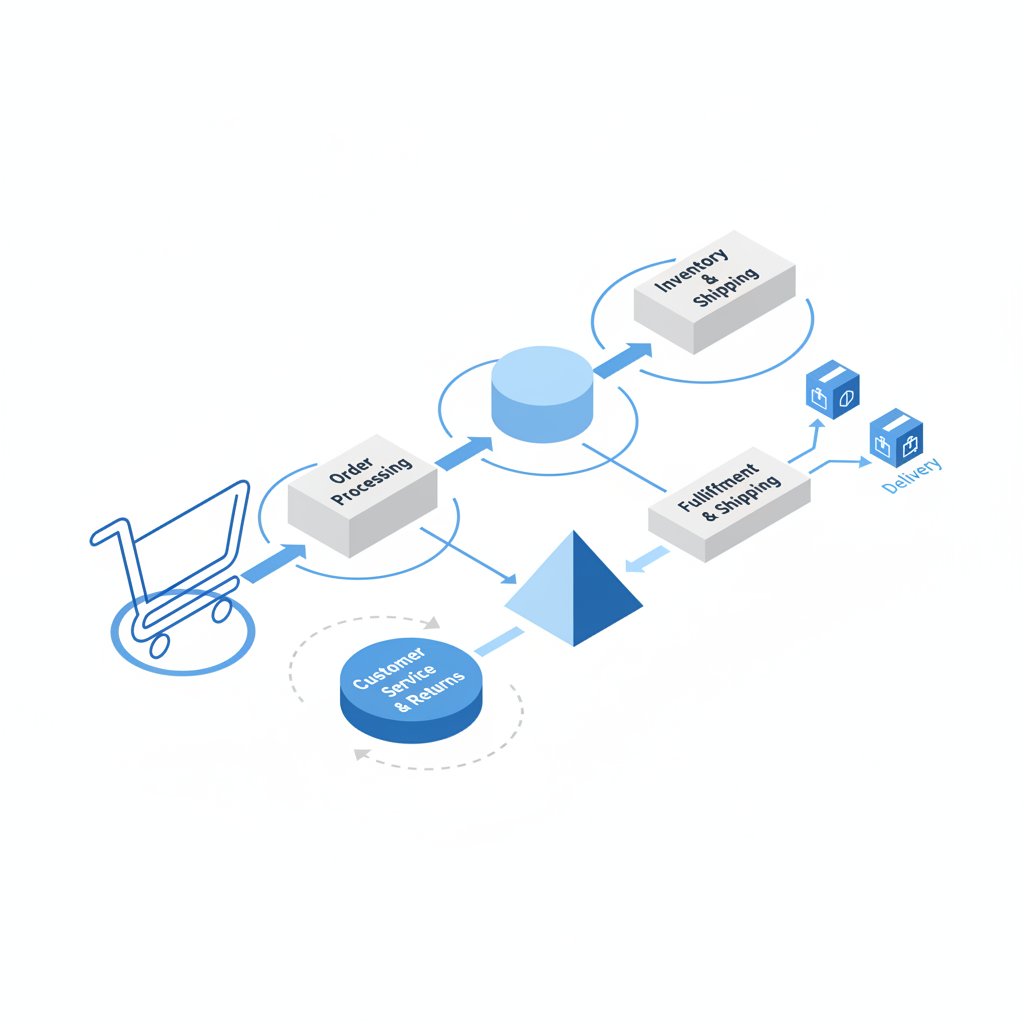
Modern e-commerce operations are virtually impossible to manage without a robust suite of technology solutions. These systems automate tasks, provide critical data, and ensure seamless coordination across various operational pillars. Choosing the right tech stack is a strategic decision that impacts scalability, efficiency, and ultimately, profitability.
Key Systems and Their Functions
| System Acronym | Full Name | Primary Function in E-commerce Ops | Key Benefits |
|---|---|---|---|
| WMS | Warehouse Management System | Manages and optimizes warehouse operations: inventory location, picking routes, receiving, putaway, and shipping. | Increases picking accuracy, improves throughput, reduces labor costs, optimizes storage space. |
| IMS | Inventory Management System | Tracks and controls inventory levels across all locations and channels, manages stock rotation, reordering, and valuation. | Prevents stockouts/overstocking, improves cash flow, accurate stock counts for sales. |
| OMS | Order Management System | Centralizes and automates the entire order lifecycle: capture, processing, routing, fulfillment, and customer communication. | Streamlines order flow, reduces manual errors, enhances customer service. |
| PIM | Product Information Management | Manages, centralizes, and distributes product data (descriptions, images, specs) across all sales channels. | Ensures consistent product data, faster product launches, reduces data entry errors. |
| ERP | Enterprise Resource Planning | An integrated suite of applications managing core business processes: finance, HR, inventory, purchasing, sales, and manufacturing. | Provides a holistic view of the business, improves financial management, enables cross-functional data sharing. |
| TMS | Transportation Management System | Optimizes the planning, execution, and tracking of goods movement, from carrier selection to route optimization. | Reduces shipping costs, improves delivery times, enhances visibility into transit. |
| CRM | Customer Relationship Management | Manages all customer interactions and data, supports customer service, marketing, and sales efforts. | Personalizes customer experience, improves retention, efficient issue resolution. |
Integration is Key
The true power of an e-commerce operations tech stack comes from the seamless integration of these systems. For instance, an OMS should integrate with a WMS to trigger fulfillment requests and update inventory levels in real-time. Similarly, your e-commerce platform (like Shopify) needs to integrate with your OMS to pass order data and receive fulfillment status updates. Disconnected systems lead to manual data entry, errors, delays, and a lack of a single source of truth, severely hampering operational efficiency.
Optimizing for Conversion & D2C Growth Through Operations
The link between robust e-commerce operations and conversion rates might not be immediately obvious, but it is profound. Every step of the customer’s journey, from browsing to product delivery, is influenced by your operational performance.
How Operations Impact the Customer Journey
- Website Experience (Pre-Purchase): Accurate inventory levels (IMS) prevent customers from ordering out-of-stock items, avoiding disappointment. Fast website load times and seamless navigation (often supported by PIM for product data) contribute to a positive browsing experience.
- Checkout (Conversion Point): Clear shipping options, accurate delivery estimates (TMS), and transparent return policies (Reverse Logistics) build trust and reduce cart abandonment.
- Post-Purchase Experience: Fast and accurate order fulfillment (OMS & WMS), proactive shipping updates (TMS), and responsive customer service (CRM) enhance satisfaction and encourage repeat purchases.
- Returns Experience: An easy and transparent returns process (Reverse Logistics) mitigates potential negative experiences and can even turn a returner into a loyal customer.
Strategies for Operational Optimization
Continuous improvement is not just a buzzword; it’s a necessity for thriving D2C brands. Here’s how to approach it:
- Automate, Automate, Automate: Identify repetitive, manual tasks across order processing, inventory updates, and customer communications, and leverage technology to automate them. This reduces human error and frees up staff for more strategic work.
- Leverage Data Analytics: Use your operational data to identify trends, pain points, and areas for improvement. Track KPIs religiously. Where are delays occurring? What products have high return rates?
- Consider 3PL Partnerships: For many D2C brands, outsourcing fulfillment to a Third-Party Logistics (3PL) provider can significantly improve efficiency, reduce costs, and provide access to advanced infrastructure and expertise, especially when scaling.
- Standardize Processes: Document clear, step-by-step procedures for every operational task. This ensures consistency, simplifies training, and reduces tribal knowledge dependency.
- Invest in Your Team: Provide ongoing training for your operations staff. Equip them with the tools and knowledge to efficiently handle their responsibilities and empower them to identify and suggest improvements.
- Proactive Communication: Implement systems to automatically notify customers about order status, shipping delays, or return updates. Transparency builds trust.
Scaling E-commerce Operations: From Startup to Enterprise
Growth is the ultimate goal for most D2C brands, but uncontrolled growth can quickly overwhelm inadequate operational systems, leading to customer dissatisfaction and financial strain. Scaling operations effectively means building a foundation that can accommodate increasing volumes without compromising quality or efficiency.
Challenges of Scaling Operations
- Increased Order Volume: Higher sales mean more orders to process, pick, pack, and ship.
- Expanded Product Catalog: More SKUs require more complex inventory management and warehouse organization.
- Geographic Expansion: Reaching new markets means navigating different shipping regulations, carriers, and potentially establishing new fulfillment centers.
- Team Growth: Expanding operational teams requires robust hiring, training, and management strategies.
- System Strain: Existing tech solutions may not be able to handle increased data volume or transaction rates.
Strategies for Scalable Operations
- Modular System Architecture: Design your tech stack with modularity in mind. Instead of an all-in-one behemoth, use best-of-breed systems (WMS, OMS, PIM) that communicate via APIs. This allows for easier upgrades or replacements of individual components without overhauling the entire system.
- Automation First Mentality: From day one, think about how to automate tasks. As volume grows, manually intensive processes become unsustainable bottlenecks.
- Strategic Outsourcing (3PLs): Partnering with a 3PL can provide instant scalability in terms of warehousing space, labor, and fulfillment expertise. They often have networks of fulfillment centers, enabling faster shipping to wider geographies. This allows D2C brands to focus on their core competencies like marketing and product development.
- Standard Operating Procedures (SOPs): Document every process. As you scale, you’ll need to onboard new team members quickly and ensure consistent quality. SOPs are invaluable for training and maintaining standards.
- Demand Planning and Forecasting: Invest heavily in robust forecasting tools and methodologies. Accurate demand predictions are crucial for managing inventory efficiently and planning for peak seasons.
- Scalable Infrastructure: Whether you manage your own warehouse or work with a 3PL, ensure the physical infrastructure (like storage capacity, material handling equipment) can grow with your business.
- Data-Driven Decision Making: Continuously monitor KPIs and use data to anticipate growth, identify potential bottlenecks, and make informed decisions about resource allocation and process improvements.
The Role of Omnichannel Fulfillment
As D2C brands grow, many explore omnichannel strategies, blurring the lines between online and offline. Omnichannel fulfillment involves unifying inventory and order management across all sales channels (e.g., e-commerce, brick-and-mortar stores, pop-ups, marketplaces) to provide a seamless customer experience. This can include:
- Buy Online, Pick Up In Store (BOPIS): Customers order online and collect from a physical store.
- Ship from Store: Using physical store inventory to fulfill online orders, reducing shipping times and optimizing stock.
- Returns to Any Channel: Allowing customers to return online purchases to a physical store, or vice-versa.
Implementing omnichannel fulfillment requires sophisticated inventory synchronization (often through a centralized OMS or IMS) and robust operational processes to track stock across an entire network, enhancing customer convenience and leveraging existing assets.
Future Trends in E-commerce Operations 2026
The e-commerce landscape is constantly evolving, and operations must adapt to keep pace. Several trends are shaping the future of D2C operational excellence.
Artificial Intelligence (AI) and Machine Learning (ML)
- Automated Forecasting: AI-powered tools are moving beyond historical data to predict demand with unprecedented accuracy, considering real-time factors like weather, social media sentiment, and competitor activity.
- Warehouse Robotics: AI-driven robots are becoming more common in warehouses for picking, packing, and sorting, significantly increasing speed, accuracy, and reducing labor costs.
- Predictive Maintenance: ML algorithms can predict when equipment in a warehouse might fail, allowing for proactive maintenance and minimizing downtime.
- Personalized Customer Service: AI chatbots are handling routine customer inquiries, freeing human agents to focus on complex issues.
Sustainability in Logistics
Consumers are increasingly demanding eco-friendly practices. E-commerce operations are responding by:
- Sustainable Packaging: Opting for recycled, recyclable, or biodegradable packaging materials.
- Optimized Delivery Routes: Using TMS to plan the most fuel-efficient delivery routes, reducing carbon emissions.
- Green Last-Mile Solutions: Exploring electric vehicles, bikes, or even drones for urban deliveries.
- Circular Economy Initiatives: Improving reverse logistics processes to encourage product repair, refurbishment, and resale, reducing waste.
Hyper-Personalization and Customization at Scale
The demand for personalized products and services is growing. Operations need to support:
- Mass Customization: Efficiently producing unique variations of products based on individual customer preferences (e.g., custom engravings, product configurations).
- Personalized Packaging: Integrating custom messaging or branding into individual packages.
- Flexible Fulfillment: Adapting fulfillment processes to handle unique kitting or assembly requirements for personalized orders.
Blockchain for Supply Chain Transparency
Blockchain technology offers the potential to create immutable, transparent records across the entire supply chain. This can:
- Enhance Traceability: Track products from raw materials to the customer’s hands, improving authenticity and quality assurance.
- Improve Supply Chain Auditing: Provide verifiable data for ethical sourcing and compliance.
- Streamline Payments: Facilitate faster and more secure payments across complex supply chain networks.
Staying abreast of these trends and strategically integrating relevant technologies and practices will be crucial for D2C brands looking to maintain a competitive edge and optimize their e-commerce operations for long-term success in 2026 and beyond.
Conclusion: The Operational Imperative for E-commerce Success
In conclusion, understanding what is e-commerce operations is not just an academic exercise; it is an imperative for any D2C brand striving for profitability, scalability, and lasting customer loyalty. From meticulous inventory management and seamless order processing to efficient shipping, empathetic customer service, and robust reverse logistics, every operational pillar plays a critical role in the overall success of an online store.
The e-commerce operations manager stands at the helm, guiding these intricate processes with a blend of strategic vision and meticulous execution. Supported by a sophisticated tech stack comprising WMS, IMS, OMS, PIM, and ERP systems, modern D2C brands can automate, optimize, and scale their back-end functions to meet the ever-increasing demands of the digital marketplace.
By prioritizing operational excellence, D2C brands can transform potential bottlenecks into competitive advantages. It’s about more than just delivering a product; it’s about delivering an exceptional end-to-end customer experience that fosters repeat business, drives positive word-of-mouth, and ultimately fuels sustainable growth. In 2026, the brands that master their operations will be the ones that truly thrive.
Frequently Asked Questions
Q1: How do you scale e-commerce operations efficiently?
A1: Scaling e-commerce operations efficiently involves several key strategies: embrace automation for repetitive tasks, partner with 3PLs for flexible warehousing and fulfillment, implement modular and integrated software systems (like WMS, OMS, ERP), establish clear Standard Operating Procedures (SOPs), and continuously analyze data to identify bottlenecks and optimize processes. It’s about building a robust, adaptable foundation rather than merely increasing capacity.
Q2: What is the difference between an OMS and a WMS?
A2: An OMS (Order Management System) primarily manages the entire order lifecycle from capture to fulfillment and customer communication, often across multiple sales channels. It ensures orders are processed correctly and routed efficiently. A WMS (Warehouse Management System), on the other hand, focuses specifically on optimizing physical warehouse operations, including inventory locating, picking, packing, receiving, and shipping of items within the warehouse itself. While distinct, they often integrate to provide a seamless operational flow.
Q3: What role does customer service play in e-commerce operations?
A3: Customer service is intrinsically linked to e-commerce operations. Many customer inquiries (e.g., “Where is my order?”, “Can I return this item?”) directly relate to operational performance. Excellent operations minimize these issues, while responsive customer service resolves them efficiently when they arise. It covers providing accurate order status, resolving shipping problems, facilitating returns, and collecting feedback that can inform operational improvements, thus reinforcing customer satisfaction and loyalty.
Q4: What is omnichannel fulfillment and why is it important?
A4: Omnichannel fulfillment involves unifying inventory and order processing across all sales channels (online, physical stores, marketplaces) to provide a seamless and consistent customer experience. It’s important because it offers customers flexibility (e.g., Buy Online, Pick Up In Store), optimizes inventory utilization by allowing physical stores to fulfill online orders (Ship from Store), reduces shipping times, and enhances overall customer convenience, leading to higher satisfaction and conversion rates.
Q5: How can D2C brands reduce shipping costs in their operations?
A5: D2C brands can reduce shipping costs by optimizing packaging to minimize dimensional weight, negotiating bulk discounts with preferred carriers, utilizing shipping software to compare rates and generate optimal labels, consolidating shipments where possible, offering various shipping speeds to customers, and strategically using regional fulfillment centers or 3PLs to shorten delivery distances and leverage zone-based pricing.
What Is E-commerce Operations? Your 2026 Guide to D2C Scaling and Profitability
Affiliate disclosure: This article may contain affiliate links. Recommendations are independent and editorially driven.
In the dynamic world of direct-to-consumer (D2C) e-commerce, merely having a great product and a beautiful website is no longer sufficient for sustained success. The true engine driving profitability, customer satisfaction, and scalable growth lies within the intricate framework of e-commerce operations. This comprehensive guide will demystify what e-commerce operations entail, focusing on how a well-oiled operational machine translates directly into higher conversion rates, streamlined processes, and ultimately, a more profitable online store.
Quick Summary (TL;DR):
- E-commerce operations encompass all the back-end processes required to deliver an online order from click to customer, efficiently and profitably.
- Key pillars include inventory management, order processing, fulfillment, shipping, customer service, and reverse logistics.
- Optimizing operations is critical for D2C brands to control costs, enhance customer experience, and achieve scalable growth in a competitive market.
- A robust tech stack and a skilled operations manager are essential for managing complexity and driving continuous improvement.
Defining E-commerce Operations: Beyond the Click
At its core, e-commerce operations refer to the entire ecosystem of activities and processes that occur behind the scenes to ensure an online order is prepared, shipped, and delivered to the customer efficiently and effectively. It’s the journey your product takes from your warehouse shelf to the customer’s doorstep, encompassing every touchpoint and decision along the way. For D2C brands, mastering these operations isn’t just about efficiency; it’s about safeguarding brand reputation, fostering customer loyalty, and directly impacting the bottom line.
The Holistic View of the E-commerce Operations Lifecycle
Think of it as a continuous loop, starting even before an order is placed and extending far beyond delivery. This includes everything from how you acquire your products to how you handle returns. Each stage presents opportunities for optimization and potential pitfalls if neglected. An integrated approach ensures that all components work in harmony, creating a seamless experience for both the business and the customer.
Why Operational Excellence Matters for D2C Growth
In the competitive D2C landscape, customers expect speed, accuracy, and transparency. Flawless operations translate directly into a superior customer experience, which in turn drives repeat purchases and positive word-of-mouth. Moreover, efficient operations reduce costs, minimize errors, and free up valuable resources that can be reinvested in marketing, product development, or other growth initiatives. Conversely, poor operations can lead to delayed shipments, incorrect orders, dissatisfied customers, and ultimately, lost sales and profits.
[INLINE IMAGE 1: place after second H2 | alt=”Flowchart showing the e-commerce operations lifecycle from inventory management to order processing, fulfillment, shipping, and reverse logistics.”]
The Pillars of E-commerce Operations: A Deep Dive
Breaking down e-commerce operations into its core components provides a clearer understanding of the complexity and interconnectivity involved. Each pillar is crucial and requires dedicated attention for optimal performance.
1. Inventory Management: The Foundation of Fulfillment
Effective inventory management is the bedrock of any successful e-commerce operation. It involves tracking, ordering, storing, and controlling a company’s inventory. Mismanaging inventory can lead to stockouts (lost sales) or overstocking (tied-up capital and increased storage costs).
- Forecasting Demand: Utilizing historical sales data, market trends, and promotional calendars to predict future product needs.
- Stock Level Optimization: Determining optimal reorder points and quantities to balance inventory costs with customer demand.
- Warehouse Organization: Structuring storage for efficient picking, packing, and order fulfillment.
- Inventory Tracking Systems: Implementing systems (IMS or WMS) to monitor stock in real-time across all sales channels.
For more insights into managing your stock, explore our Advanced Inventory Forecasting Guide.
2. Order Processing: From Click to Confirmation
This pillar encompasses all activities from the moment a customer places an order until it is ready for fulfillment. Efficiency here is key to setting the stage for timely delivery.
- Order Capture: Ensuring seamless collection of order details from your e-commerce platform (e.g., Shopify).
- Payment Processing: Securely handling transactions and managing potential payment failures.
- Order Verification: Validating order details, checking for fraud, and confirming stock availability.
- Order Routing: Directing orders to the appropriate fulfillment center or warehouse if you have multiple locations.
3. Fulfillment: The Heart of the Operation
Fulfillment is where the physical journey of the product begins. It’s the process of preparing a customer’s order for shipment.
- Picking: Locating and retrieving items from warehouse shelves. Accuracy and speed are paramount to avoid errors.
- Packing: Carefully boxing or bagging items, often including dunnage, promotional materials, and branded packaging.
- Quality Control: Ensuring the correct items, quantities, and quality standards are met before sealing the package.
- Kitting & Assembly: For bundles or custom products, this involves grouping multiple items into a single SKU or assembling components.
4. Shipping & Logistics: The Final Mile and Beyond
Once an order is packed, shipping takes over. This involves choosing carriers, managing costs, and ensuring timely delivery.
- Carrier Selection: Partnering with appropriate shipping carriers (e.g., UPS, FedEx, USPS, DHL) based on speed, cost, and destination.
- Shipping Rate Optimization: Negotiating rates, utilizing shipping software, and strategically passed discounts to customers.
- Last-Mile Delivery: The final leg of the delivery journey, often the most expensive and complex.
- Tracking & Communication: Providing customers with real-time tracking information and proactive updates.
[INLINE IMAGE 2: place after fourth H2 | alt=”Comparison chart detailing the pros and cons of in-house fulfillment versus 3PL (third-party logistics) for e-commerce businesses.”]
5. Customer Service: The Human Element
While often seen as a front-end function, excellent customer service is deeply intertwined with operations. Many customer inquiries stem from operational issues.
- Order Status Inquiries: Providing quick and accurate information on order progression.
- Shipping Issues Resolution: Addressing lost packages, damaged goods, or delayed deliveries.
- Return and Exchange Support: Guiding customers through the reverse logistics process.
- Feedback Collection: Using customer feedback to identify and resolve underlying operational inefficiencies.
6. Reverse Logistics (Returns Management): Closing the Loop Profitably
Often overlooked, reverse logistics—the process of managing returns, exchanges, and repairs—is a critical, profit-impacting aspect of e-commerce operations. A smooth return process can turn a potential negative experience into a positive one, influencing future purchases.
- Return Policy Design: Crafting clear, fair, and easy-to-understand return policies that balance customer satisfaction with business costs.
- Return Authorization (RMA): Implementing systems for customers to initiate and track returns, generating return labels, and providing detailed instructions.
- Return Shipping & Receiving: Managing the inbound shipping of returned items and their formal receipt into the warehouse.
- Inspection & Processing: Assessing returned goods for condition, determining if they can be restocked, refurbished, or disposed of.
- Refunds & Exchanges: Promptly processing refunds or sending out exchange items according to policy.
- Data Analysis: Tracking return reasons and rates to identify product issues, improve descriptions, or adjust operational processes to reduce future returns.
Efficient reverse logistics not only minimizes financial losses from returns but also enhances customer perception. A complicated or lengthy return process is a major deterrent for customers considering future purchases.
The E-commerce Operations Manager: Architect of Efficiency
The role of an E-commerce Operations Manager is pivotal, acting as the orchestrator of all the intricate processes described above. This is not merely an administrative position but a strategic one, directly influencing profitability and customer satisfaction.
Key Responsibilities and Daily Activities
- Process Optimization: Continuously reviewing and refining workflows across inventory, fulfillment, shipping, and returns to identify bottlenecks and improve efficiency. This often involves mapping current states and designing future states for key processes.
- Vendor Management: Overseeing relationships with third-party logistics (3PLs), shipping carriers, packaging suppliers, and technology providers. Negotiating contracts and monitoring service level agreements (SLAs).
- Technology Integration: Evaluating, implementing, and managing the various software systems (WMS, OMS, ERP, PIM) that form the operational tech stack. Ensuring data flows seamlessly between systems.
- Team Leadership & Development: Managing warehouse staff, customer service teams, or external partners. Training, performance monitoring, and fostering a culture of operational excellence.
- Data Analysis & Reporting: Tracking key performance indicators (KPIs) such as order fulfillment time, shipping costs per order, return rates, inventory turnover, and customer service response times. Generating reports to inform strategic decisions.
- Risk Management: Identifying potential disruptions (e.g., supply chain issues, shipping delays, fraud) and developing contingency plans.
- Cross-Functional Collaboration: Working closely with marketing, sales, product development, and finance teams to align operational capabilities with business goals and new initiatives (e.g., launching a new product, running a flash sale).
Essential Skills for an E-commerce Operations Manager
- Analytical Thinking: Ability to dive deep into data, identify trends, and make data-driven decisions.
- Problem-Solving: Quick and effective resolution of operational challenges.
- Project Management: Overseeing complex projects, from system integrations to warehouse layout improvements.
- Communication: Clear and concise interaction with internal teams, vendors, and customers.
- Tech Savvy: Proficiency with various e-commerce platforms and operational software.
The E-commerce Operations Tech Stack: Powering Performance
Modern e-commerce operations are virtually impossible to manage without a robust suite of technology solutions. These systems automate tasks, provide critical data, and ensure seamless coordination across various operational pillars. Choosing the right tech stack is a strategic decision that impacts scalability, efficiency, and ultimately, profitability.
Key Systems and Their Functions
| System Acronym | Full Name | Primary Function in E-commerce Ops | Key Benefits |
|---|---|---|---|
| WMS | Warehouse Management System | Manages and optimizes warehouse operations: inventory location, picking routes, receiving, putaway, and shipping. | Increases picking accuracy, improves throughput, reduces labor costs, optimizes storage space. |
| IMS | Inventory Management System | Tracks and controls inventory levels across all locations and channels, manages stock rotation, reordering, and valuation. | Prevents stockouts/overstocking, improves cash flow, accurate stock counts for sales. |
| OMS | Order Management System | Centralizes and automates the entire order lifecycle: capture, processing, routing, fulfillment, and customer communication. | Streamlines order flow, reduces manual errors, enhances customer service. |
| PIM | Product Information Management | Manages, centralizes, and distributes product data (descriptions, images, specs) across all sales channels. | Ensures consistent product data, faster product launches, reduces data entry errors. |
| ERP | Enterprise Resource Planning | An integrated suite of applications managing core business processes: finance, HR, inventory, purchasing, sales, and manufacturing. | Provides a holistic view of the business, improves financial management, enables cross-functional data sharing. |
| TMS | Transportation Management System | Optimizes the planning, execution, and tracking of goods movement, from carrier selection to route optimization. | Reduces shipping costs, improves delivery times, enhances visibility into transit. |
| CRM | Customer Relationship Management | Manages all customer interactions and data, supports customer service, marketing, and sales efforts. | Personalizes customer experience, improves retention, efficient issue resolution. |
Integration is Key
The true power of an e-commerce operations tech stack comes from the seamless integration of these systems. For instance, an OMS should integrate with a WMS to trigger fulfillment requests and update inventory levels in real-time. Similarly, your e-commerce platform (like Shopify) needs to integrate with your OMS to pass order data and receive fulfillment status updates. Disconnected systems lead to manual data entry, errors, delays, and a lack of a single source of truth, severely hampering operational efficiency.
Optimizing for Conversion & D2C Growth Through Operations
The link between robust e-commerce operations and conversion rates might not be immediately obvious, but it is profound. Every step of the customer’s journey, from browsing to product delivery, is influenced by your operational performance.
How Operations Impact the Customer Journey
- Website Experience (Pre-Purchase): Accurate inventory levels (IMS) prevent customers from ordering out-of-stock items, avoiding disappointment. Fast website load times and seamless navigation (often supported by PIM for product data) contribute to a positive browsing experience.
- Checkout (Conversion Point): Clear shipping options, accurate delivery estimates (TMS), and transparent return policies (Reverse Logistics) build trust and reduce cart abandonment.
- Post-Purchase Experience: Fast and accurate order fulfillment (OMS & WMS), proactive shipping updates (TMS), and responsive customer service (CRM) enhance satisfaction and encourage repeat purchases.
- Returns Experience: An easy and transparent returns process (Reverse Logistics) mitigates potential negative experiences and can even turn a returner into a loyal customer.
Strategies for Operational Optimization
Continuous improvement is not just a buzzword; it’s a necessity for thriving D2C brands. Here’s how to approach it:
- Automate, Automate, Automate: Identify repetitive, manual tasks across order processing, inventory updates, and customer communications, and leverage technology to automate them. This reduces human error and frees up staff for more strategic work.
- Leverage Data Analytics: Use your operational data to identify trends, pain points, and areas for improvement. Track KPIs religiously. Where are delays occurring? What products have high return rates?
- Consider 3PL Partnerships: For many D2C brands, outsourcing fulfillment to a Third-Party Logistics (3PL) provider can significantly improve efficiency, reduce costs, and provide access to advanced infrastructure and expertise, especially when scaling.
- Standardize Processes: Document clear, step-by-step procedures for every operational task. This ensures consistency, simplifies training, and reduces tribal knowledge dependency.
- Invest in Your Team: Provide ongoing training for your operations staff. Equip them with the tools and knowledge to efficiently handle their responsibilities and empower them to identify and suggest improvements.
- Proactive Communication: Implement systems to automatically notify customers about order status, shipping delays, or return updates. Transparency builds trust.
Scaling E-commerce Operations: From Startup to Enterprise
Growth is the ultimate goal for most D2C brands, but uncontrolled growth can quickly overwhelm inadequate operational systems, leading to customer dissatisfaction and financial strain. Scaling operations effectively means building a foundation that can accommodate increasing volumes without compromising quality or efficiency.
Challenges of Scaling Operations
- Increased Order Volume: Higher sales mean more orders to process, pick, pack, and ship.
- Expanded Product Catalog: More SKUs require more complex inventory management and warehouse organization.
- Geographic Expansion: Reaching new markets means navigating different shipping regulations, carriers, and potentially establishing new fulfillment centers.
- Team Growth: Expanding operational teams requires robust hiring, training, and management strategies.
- System Strain: Existing tech solutions may not be able to handle increased data volume or transaction rates.
Strategies for Scalable Operations
- Modular System Architecture: Design your tech stack with modularity in mind. Instead of an all-in-one behemoth, use best-of-breed systems (WMS, OMS, PIM) that communicate via APIs. This allows for easier upgrades or replacements of individual components without overhauling the entire system.
- Automation First Mentality: From day one, think about how to automate tasks. As volume grows, manually intensive processes become unsustainable bottlenecks.
- Strategic Outsourcing (3PLs): Partnering with a 3PL can provide instant scalability in terms of warehousing space, labor, and fulfillment expertise. They often have networks of fulfillment centers, enabling faster shipping to wider geographies. This allows D2C brands to focus on their core competencies like marketing and product development.
- Standard Operating Procedures (SOPs): Document every process. As you scale, you’ll need to onboard new team members quickly and ensure consistent quality. SOPs are invaluable for training and maintaining standards.
- Demand Planning and Forecasting: Invest heavily in robust forecasting tools and methodologies. Accurate demand predictions are crucial for managing inventory efficiently and planning for peak seasons.
- Scalable Infrastructure: Whether you manage your own warehouse or work with a 3PL, ensure the physical infrastructure (like storage capacity, material handling equipment) can grow with your business.
- Data-Driven Decision Making: Continuously monitor KPIs and use data to anticipate growth, identify potential bottlenecks, and make informed decisions about resource allocation and process improvements.
The Role of Omnichannel Fulfillment
As D2C brands grow, many explore omnichannel strategies, blurring the lines between online and offline. Omnichannel fulfillment involves unifying inventory and order management across all sales channels (e.g., e-commerce, brick-and-mortar stores, pop-ups, marketplaces) to provide a seamless customer experience. This can include:
- Buy Online, Pick Up In Store (BOPIS): Customers order online and collect from a physical store.
- Ship from Store: Using physical store inventory to fulfill online orders, reducing shipping times and optimizing stock.
- Returns to Any Channel: Allowing customers to return online purchases to a physical store, or vice-versa.
Implementing omnichannel fulfillment requires sophisticated inventory synchronization (often through a centralized OMS or IMS) and robust operational processes to track stock across an entire network, enhancing customer convenience and leveraging existing assets.
Future Trends in E-commerce Operations 2026
The e-commerce landscape is constantly evolving, and operations must adapt to keep pace. Several trends are shaping the future of D2C operational excellence.
Artificial Intelligence (AI) and Machine Learning (ML)
- Automated Forecasting: AI-powered tools are moving beyond historical data to predict demand with unprecedented accuracy, considering real-time factors like weather, social media sentiment, and competitor activity.
- Warehouse Robotics: AI-driven robots are becoming more common in warehouses for picking, packing, and sorting, significantly increasing speed, accuracy, and reducing labor costs.
- Predictive Maintenance: ML algorithms can predict when equipment in a warehouse might fail, allowing for proactive maintenance and minimizing downtime.
- Personalized Customer Service: AI chatbots are handling routine customer inquiries, freeing human agents to focus on complex issues.
Sustainability in Logistics
Consumers are increasingly demanding eco-friendly practices. E-commerce operations are responding by:
- Sustainable Packaging: Opting for recycled, recyclable, or biodegradable packaging materials.
- Optimized Delivery Routes: Using TMS to plan the most fuel-efficient delivery routes, reducing carbon emissions.
- Green Last-Mile Solutions: Exploring electric vehicles, bikes, or even drones for urban deliveries.
- Circular Economy Initiatives: Improving reverse logistics processes to encourage product repair, refurbishment, and resale, reducing waste.
Hyper-Personalization and Customization at Scale
The demand for personalized products and services is growing. Operations need to support:
- Mass Customization: Efficiently producing unique variations of products based on individual customer preferences (e.g., custom engravings, product configurations).
- Personalized Packaging: Integrating custom messaging or branding into individual packages.
- Flexible Fulfillment: Adapting fulfillment processes to handle unique kitting or assembly requirements for personalized orders.
Blockchain for Supply Chain Transparency
Blockchain technology offers the potential to create immutable, transparent records across the entire supply chain. This can:
- Enhance Traceability: Track products from raw materials to the customer’s hands, improving authenticity and quality assurance.
- Improve Supply Chain Auditing: Provide verifiable data for ethical sourcing and compliance.
- Streamline Payments: Facilitate faster and more secure payments across complex supply chain networks.
Staying abreast of these trends and strategically integrating relevant technologies and practices will be crucial for D2C brands looking to maintain a competitive edge and optimize their e-commerce operations for long-term success in 2026 and beyond.
Conclusion: The Operational Imperative for E-commerce Success
In conclusion, understanding what is e-commerce operations is not just an academic exercise; it is an imperative for any D2C brand striving for profitability, scalability, and lasting customer loyalty. From meticulous inventory management and seamless order processing to efficient shipping, empathetic customer service, and robust reverse logistics, every operational pillar plays a critical role in the overall success of an online store.
The e-commerce operations manager stands at the helm, guiding these intricate processes with a blend of strategic vision and meticulous execution. Supported by a sophisticated tech stack comprising WMS, IMS, OMS, PIM, and ERP systems, modern D2C brands can automate, optimize, and scale their back-end functions to meet the ever-increasing demands of the digital marketplace.
By prioritizing operational excellence, D2C brands can transform potential bottlenecks into competitive advantages. It’s about more than just delivering a product; it’s about delivering an exceptional end-to-end customer experience that fosters repeat business, drives positive word-of-mouth, and ultimately fuels sustainable growth. In 2026, the brands that master their operations will be the ones that truly thrive.
Frequently Asked Questions
Q1: How do you scale e-commerce operations efficiently?
A1: Scaling e-commerce operations efficiently involves several key strategies: embrace automation for repetitive tasks, partner with 3PLs for flexible warehousing and fulfillment, implement modular and integrated software systems (like WMS, OMS, ERP), establish clear Standard Operating Procedures (SOPs), and continuously analyze data to identify bottlenecks and optimize processes. It’s about building a robust, adaptable foundation rather than merely increasing capacity.
Q2: What is the difference between an OMS and a WMS?
A2: An OMS (Order Management System) primarily manages the entire order lifecycle from capture to fulfillment and customer communication, often across multiple sales channels. It ensures orders are processed correctly and routed efficiently. A WMS (Warehouse Management System), on the other hand, focuses specifically on optimizing physical warehouse operations, including inventory locating, picking, packing, receiving, and shipping of items within the warehouse itself. While distinct, they often integrate to provide a seamless operational flow.
Q3: What role does customer service play in e-commerce operations?
A3: Customer service is intrinsically linked to e-commerce operations. Many customer inquiries (e.g., “Where is my order?”, “Can I return this item?”) directly relate to operational performance. Excellent operations minimize these issues, while responsive customer service resolves them efficiently when they arise. It covers providing accurate order status, resolving shipping problems, facilitating returns, and collecting feedback that can inform operational improvements, thus reinforcing customer satisfaction and loyalty.
Q4: What is omnichannel fulfillment and why is it important?
A4: Omnichannel fulfillment involves unifying inventory and order processing across all sales channels (online, physical stores, marketplaces) to provide a seamless and consistent customer experience. It’s important because it offers customers flexibility (e.g., Buy Online, Pick Up In Store), optimizes inventory utilization by allowing physical stores to fulfill online orders (Ship from Store), reduces shipping times, and enhances overall customer convenience, leading to higher satisfaction and conversion rates.
Q5: How can D2C brands reduce shipping costs in their operations?
A5: D2C brands can reduce shipping costs by optimizing packaging to minimize dimensional weight, negotiating bulk discounts with preferred carriers, utilizing shipping software to compare rates and generate optimal labels, consolidating shipments where possible, offering various shipping speeds to customers, and strategically using regional fulfillment centers or 3PLs to shorten delivery distances and leverage zone-based pricing.
